Why Does Utility Software Work So Differently Than Every Other Industry?
After 13 years working alongside electric cooperatives, that community will always feel like home to me. This year was my first TechAdvantage attending as a software partner. As many people like to joke, I’ve crossed over to the “dark side.” But in this role, I’ve had the chance to see even more of the challenges co-ops face and they are remarkably similar in the demand response space. I may have switched sides, but I’m still trying to keep the balance in the Force.
Cooperatives have long been champions of Demand Response and as generation and transmission costs rise quickly, they’ve never been more interested. I was on a panel with Rodney of GRE where he shared that since the 80s they have enrolled 300,000 devices with 700,000 total members. Find me a utility that has that much program participation!
There are definitely still some challenges. Now that I’m on the software side, I find myself asking a simple question: why doesn’t utility software work the way other software does? Across conversations and sessions which mostly focused on DERMS and other DER software, four themes kept coming up:
- Software vendors charging for DER integrations that already exist
- Cooperatives being asked to manage OEM relationships themselves
- Questions around how to notify customers about DR events
- Residential program ROI stretching to seven or eight years
Why Are Utilities Being Charged for DER Integrations That Already Exist?
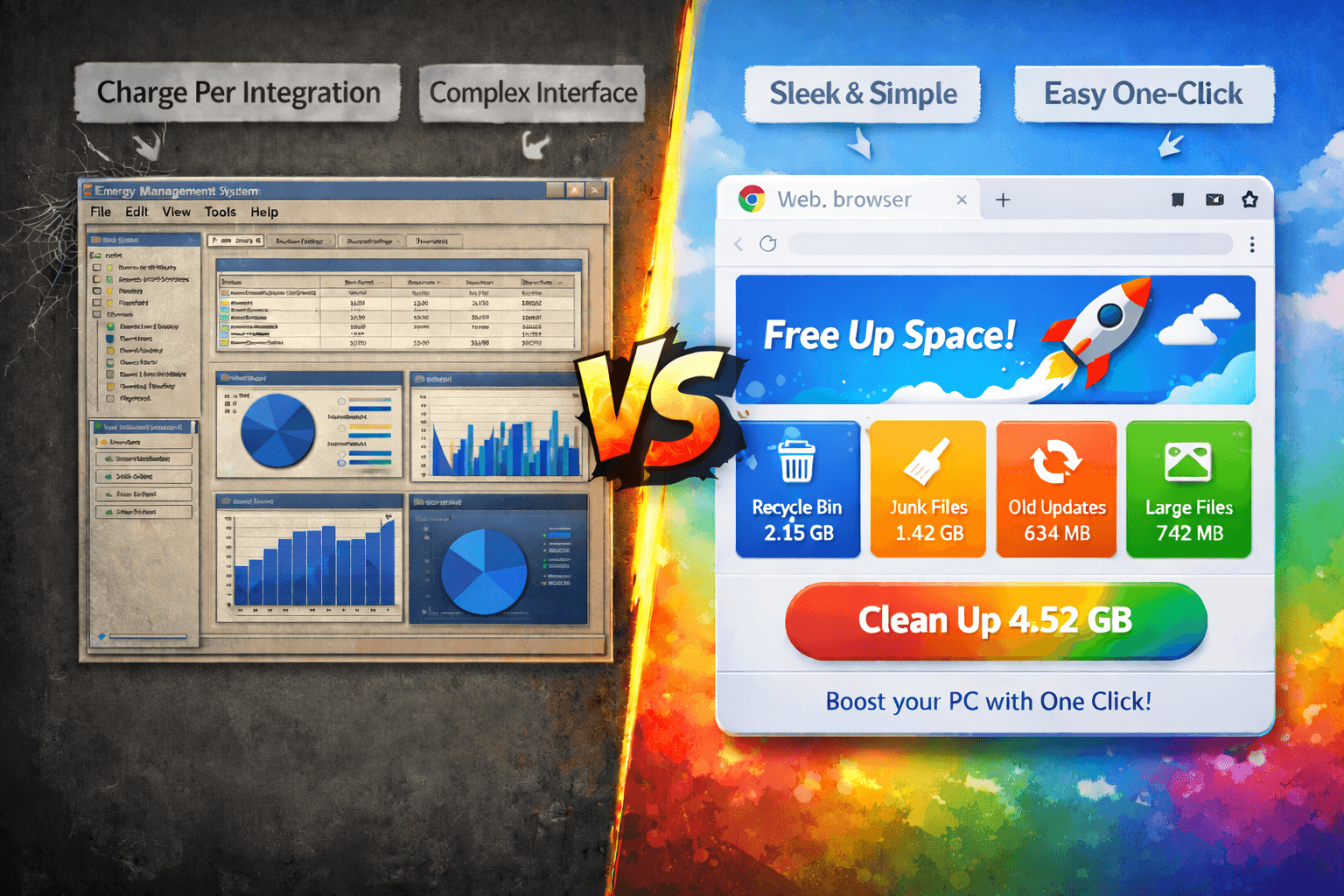
Imagine if your web browser worked like utility software does today. The address bar only works with a list of 200 pre-approved websites. If you want to switch from Gmail to Google Maps, you have to call your browser vendor, submit a change request, wait 6–18 months, and pay a $40,000 integration fee. Bookmarks don’t sync across devices.
It sounds ridiculous, but that’s effectively the reality many cooperatives face when running DER programs today. Even worse, in many cases, software vendors have already integrated these OEMs into their software, so why are they charging for it?
Cooperatives with existing programs are often forced to limit participation to a small group of OEMs simply because the current systems make integrating all OEMs expensive. It’s the number one frustration I hear from co-ops with active DER programs. Consider this: out of roughly 850 electric cooperatives nationwide, only about 10 have residential battery programs deployed.
Cooperatives care deeply about maintaining strong relationships with their members, and that means giving them choice. The real question is: why can’t we make it easier for them to do that?
Why Are Cooperatives Being Asked to Manage OEM Relationships?
Imagine downloading Chrome because it says it supports the whole internet. But when you try to visit a new site, a message appears: “This site is not currently supported.” To access it, you have to contact the website company, negotiate a partnership, gather their technical docs, and coordinate with the Chrome team to add it.
And after months of work, congratulations… you can finally open one more website. Meanwhile everyone else is just typing URLs and hitting enter.
You would think that if you sign a contract to integrate a variety of OEMs that your involvement in the relationship with those OEMs would be minimal. That's ultimately the whole purpose of a DERMS system after all, each utility does not have the resources to maintain relationships with every device OEM and honestly each OEM doesn't want to do that either. I heard from several cooperatives that the responsibility to integrate with a particular battery vendor fell on them. In other words, they needed to build the OEM relationship, they needed to get the terms and conditions, they needed to do all the work to bring that OEM into the program.
How Should Customers Be Notified About Demand Response Events?
You open your laptop in the morning, try to load a page, and nothing works. No message. No alert. No little banner that says “Something went wrong.” The browser just quietly stops doing what it’s supposed to do. Meanwhile, websites aren’t loading, links aren’t opening, and you’re left wondering if the problem is your Wi-Fi, your computer, or the internet itself.
That’s basically the equivalent of what I heard from a DERMS vendor in a session. They recommended not notifying customers when demand response events occur.
For some devices, I can understand the thinking. A battery sitting quietly in the garage probably doesn’t need to send you a message every time it helps the grid. Those systems are meant to operate in the background. But thermostats, water heaters, and EVs are different. Those devices are tied directly to how people live their daily lives. They heat your home, give you hot water, and make sure your car is ready when you need to get somewhere. When something changes how those devices behave, people notice.
A simple notification can go a long way. Even if many customers swipe it away or ignore it, the message still matters. It helps people understand what’s happening and why. Over time, that kind of transparency builds trust. These moments create feedback loops that shape the overall customer experience. It’s not really about the notification itself. It’s about taking a customer-centered approach to how the software communicates and keeps people informed.
Why Is Residential DER Program ROI So Long?
By now you’re probably tired of the browser analogy, so I’ll spare you another one here. If you’d like, feel free to imagine what a multi-year ROI browser purchase might look like on your own.
While I was at VEC (and yes, you may eventually get tired of hearing me reference it), our goal when launching a residential program was simple: show a return in less than three years, and ideally within the first year. I've written about this before - The Silent Killer of DER Program Value: Edge DERMS Costs. And yet many cooperatives are staring at a five-to-eight-year ROI for DERMS investments
Why? From what I’ve seen, it usually comes down to two things: software economics and deployment timelines.
Most programs start small. A co-op might begin with 10 batteries, hoping to grow to 100, then 1,000, and maybe far beyond that over time. From the conversations I’ve had, almost every cooperative in the country already has at least 50 batteries somewhere on their system, even those serving just 5,000–10,000 meters. But enrolling devices takes time, and typical DERMS contracts come with a significant fixed annual fee regardless of how many devices are actually participating.
On top of that, DERMS deployments and the associated device integrations often take 12–18 months before a single member is even enrolled. So utilities end up paying for the platform long before the program has the scale needed to generate meaningful value.
Software in this space should be flexible, quick to deploy, and able to scale with use. The economics should grow with the program, not get ahead of it. A good mental model is Amazon AWS. Companies don’t buy a fixed amount of servers upfront and hope they eventually grow into them. They start small, spin up what they need, and scale as demand grows. If the grid software ecosystem worked more like that, cooperatives could start delivering value quickly and expand programs based on real results rather than long-term bets.
Where the Industry Goes From Here
The encouraging part is that the industry is starting to recognize these gaps. Utilities, vendors, and device manufacturers all want the same thing: programs that scale, deliver real system value, and work well for members. The next step is reducing friction. We can have stronger OEM integrations, speed up deployments, and align software economics with how programs actually grow. If we get those pieces right, cooperatives will be able to move much faster in turning distributed energy resources into reliable grid assets.
