I know many of you have been curious, and I wanted to do more than post the usual “new job bicycle” LinkedIn GIF to share this update. I’m incredibly excited to be joining Texture and to help build the next generation of software designed specifically for utilities.
The Challenge
The grid has never been more stressed and grid operators have never had more software to manage.
Rapid load growth and the increasing penetration of intermittent renewables are forcing utilities to find new ways to maintain reliability and affordability. At the same time, the growing alphabet soup of systems—DERMS, SCADA, ADMS, AMI, CIS, MDM, OMS has made grid operations more complex, not less.
In many cases, DER data that would be incredibly valuable to grid operators is locked away in applications designed primarily for energy program staff. At VEC, we built a lot of good solutions, but the reality was that teams were constantly tab-jockeying between systems. Most of the utilities we worked with didn’t have a true single source of truth for the data they were using.
The result? Slower decision-making, higher operational risk, and teams spending more time reconciling data than actually operating the grid.
I’ve spent enough time in the utility technology space to understand just how difficult it is to build truly integrated software on top of incumbent systems. At VEC, every integration had to be justified, partnerships had to be made cost-effective, and we ultimately limited the number of incumbents we worked with due to slow deployment timelines. What we built did work—but it took significant effort to maintain relationships, and the integrations themselves were often fragile.
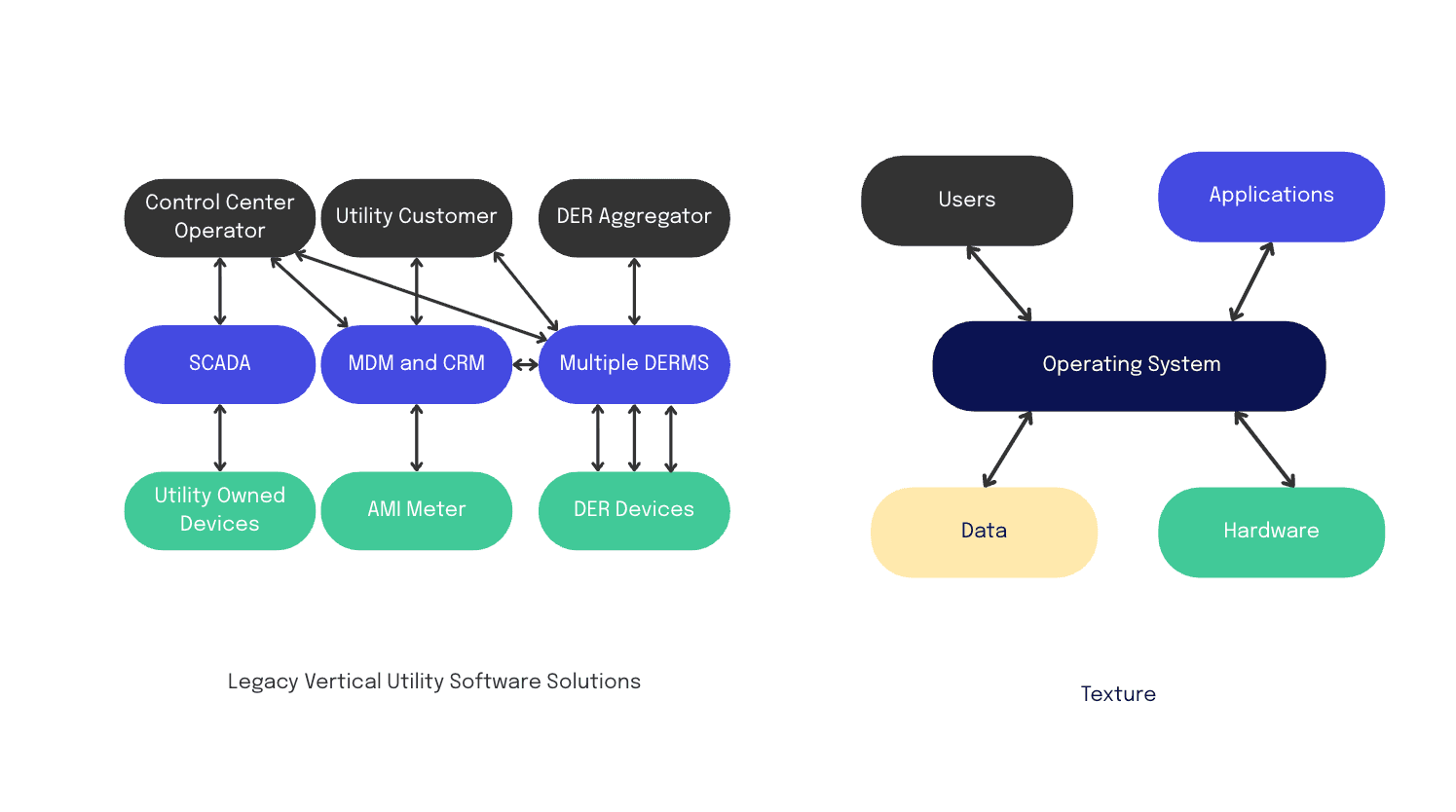
The diagram below is a simplified version of what we created, but it captures the core challenge many utilities still face today: numerous data sources, siloed applications, and users who don’t always have the data they need, when they need it.

And just as soon as we got one integration working, another need or another data source would arise.
So what is Texture?
I’ve heard many versions of the same question about Texture:
- Are they a DERMS?
- Aren’t they just doing integrations?
- What does “AI-native” even mean?
- Do they work with utilities or just OEMs?
Texture is building a grid operating system designed to disrupt the legacy platforms that keep utility teams stuck in a fragmented web of outdated technology.
The problem we’re solving isn’t data integration for its own sake. We want to ensure the right data is available where it’s needed, so utilities can coordinate decisions and operations across the entire organization. So what does that look like in practice?

The operating system is built on data and hardware integrations that power applications developed by Texture or maintained by third parties—all focused on delivering value to the end utility user.
Texture has been building tools for DER OEM’s and aggregators for several years. I joined the team as we’re building our first utility product: DER program operations. But that won’t be the last. Our vision is much bigger: a modern, shared, AI-enabled data backbone purpose-built for real-time utility operations. A reliable foundation that adapts and compounds in value over time. For example, if a cooperative is struggling to ingest multiple types of power quality data from its AMI system into an existing MDM, we enable that—and then build the applications needed to actually use that data operationally.
It’s a vision that resonated with me immediately. Start with robust data integrations, build the system with smart and curious people, and stay focused on developing products that deliver real value to the people operating the grid every day.
What is my Role?
I truly loved my role as Innovation and Technology Leader at Vermont Electric Cooperative. It gave me the opportunity to build bridges across internal silos, stay curious, and collaborate with electric cooperatives and software vendors across the country.
At Texture, I get to do many of the same things I enjoyed at VEC but now on a national scale. As Director of Market Development, I sit at the intersection of sales, product, and marketing, with a strong focus on identifying where the real problems actually lie. Utilities have never been more important. Ensuring they have trusted, modern, and affordable tools is essential to delivering reliable power in an increasingly complex grid.
My goals are clear:
- Listen to the market - Talk with as many cooperatives as possible to understand the real challenges facing member service representatives, control center operators, program administrators, and engineers. I know VEC’s challenges well and now I want to see how they align across the broader cooperative landscape. At the same time, I’ll continue listening to perspectives from OEMs, software players, IOUs, and municipal utilities to ensure we stay grounded in the realities of the industry.
- Write often - Share those challenges publicly, along with what we’re learning and where Texture is succeeding. I don’t plan to publish generic case studies like the ones legacy vendors rely on. I’m far more interested in content like what you see from EnergyHub and Camus. These examples are 95% about the problem and 5% about the solution.
- Build - Help the Texture team expand our Program Operations solution and, more importantly, build tools that deliver real, measurable value to utilities.
- Convene - Establish a cohort of innovative cooperatives. If you’re part of a co-op and reading this, I’d love to connect. We’re forming a working group to help shape our future products and to connect the incredible utility professionals making a real difference across the industry.
Texture is building a better way to operate the grid. We're building software with utilities, come join us.
