As grid stress remains top-of-mind for utility leaders and members look for more ways to save on energy costs, many co-ops across the country are considering diversifying their demand response program offerings. And since it's often easier to tackle one large DR project at a time, the question is which new program to pursue first.
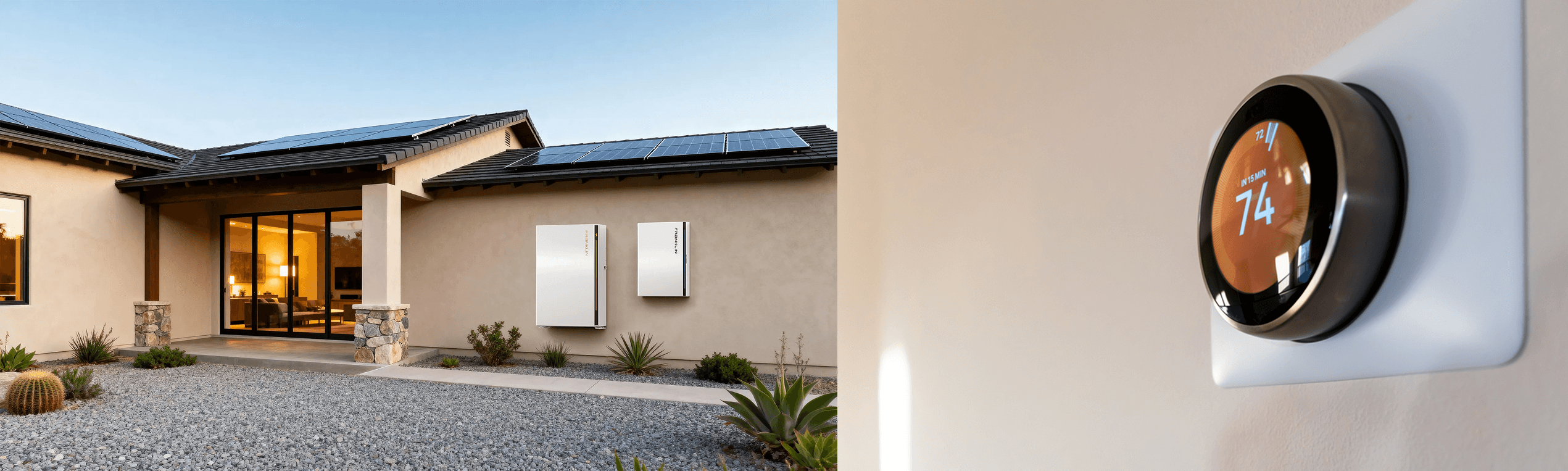
The two paths that we see co-ops taking most often are home battery programs and smart thermostat programs. While both are valuable in the long run, one might be a better starting point than the other for your specific co-op. Here, we'll run through the pros and cons of each program type, as well as what those pros and cons might mean for you.
The short answer for the time constrained: Start with batteries when you need higher, more predictable impact per device and can absorb a larger upfront investment. Start with thermostats when you want a lower-cost entry point, have a large addressable device base, and are prepared to actively manage member engagement and performance variability.
Vermont Electric Cooperative increased its energy program offerings with a 12+ OEM battery program, without the hassle of 12 separate integration contracts. Read the case study to learn how →
Battery programs: a smaller number of high-impact devices

Co-ops are often drawn to battery programs because of the large amount of impact each individual device can make. In the right location, a residential battery can help defer a transformer capacity upgrade.
And there's plenty more to love, too. Some other marquee positives for investing in a battery program are:
Low friction for members
Members see value in upgrading their home's infrastructure and safeguarding against unexpected power outages, making the initial hardware investment in a residential battery a straightforward value proposition. In the long term, these programs typically remain low-friction, partly because changes in battery status don't tend to influence a member's comfort at home. As long as you're paying some attention to technical support and participant communication, a battery program has the potential to be a great boon for member satisfaction.
Lower-touch day-to-day operation
Battery programs still require thoughtful setup, including reserve floors, dispatch policies, integrations, and member communication. Once those foundations are in place, however, their day-to-day operation can be more constrained and predictable than thermostat programs, where comfort preferences and overrides introduce additional variability.
Many programs establish a reserve floor, often between 20%–40%, depending on their risk tolerance and the program's maturity. Although battery dispatch still requires careful policy design, its primary operating states are generally more constrained than the range of possible thermostat setpoints and member overrides. This can make battery programs less complicated and more predictable to manage.
More predictable performance modeling
You know the capacity of your members' batteries and how many of those batteries are in your service area. With the hardware and software available today, you likely also know how many of those batteries are connected and ready to participate in events. That makes ROI calculations straightforward, especially if you don't need to consider event-level overrides or opt-outs.
Future infrastructure improvements can stack on top
A residential battery is often a big investment for a member, even with utility incentives. But a battery paves the way for future improvements while bringing value today. For example, a member could install a residential battery this year, then add solar in stages over the next few years, and none of that equipment is ever sitting idle waiting for another investment. Residential batteries are the hardware that keeps on giving for everybody involved.
A Rocky Mountain IOU and global grid technology provider scale a residential battery program to 2,000+ batteries and 40+MWh with Texture. Read the case study to learn how →
On the other hand, battery programs tend to have a higher barrier to entry for both the co-op and the member. Among the reasons you might think twice about starting with a battery program are:
Technical hurdles, especially with integrations
Although a battery program can be "set it and forget it," you still have to set it. Between installing the physical hardware, figuring out integrations, and teaching members how to set up any necessary software on their end, you can run into a few headaches in the implementation phase.
If integrations with manufacturers are your main pain point, a partner like Texture can help eliminate the long contracting periods. Texture holds master service agreements (MSAs) with battery manufacturers like Tesla and Enphase, allowing utilities to leverage device integrations from day one without the integration hassle.
Higher investment per device
Each residential battery is an order of magnitude greater financial investment than a thermostat. While you can certainly run a battery program with just a few residential batteries, the hardware costs for even a handful of units can be substantial.
Thermostat programs: many small drops in the bucket

If battery programs leverage a few devices to pack a big punch, thermostat programs argue that many hands make light work. Each thermostat might contribute 0.5 kWh of energy reduction during an event, but thousands of those thermostats working together can create a measurable impact.
Thermostat programs are beloved by many co-ops and their members, in part because these programs offer:
Opportunity for low-tech or high-tech interventions
Some co-ops choose to run active demand response programs, directly adjusting thermostat setpoints to manage load during peaks. But smart thermostats also play well with lower-tech monitored behavioral programs, where utilities ask members to adjust their thermostats themselves, then monitor and incentivize positive behavior after the fact. There are even manufacturer-led programs, like Renew Home's VPP program, that can make a middle ground solution more achievable.
Best of all, the same hardware supports multiple program structure options, so if you change your mind on an approach after a pilot program, it's relatively easy to switch tactics.
Gamification options are available to increase member participation
Thermostat programs are also good candidates for gamification, since the events are typically short and members can often choose how intensely to participate. Members can choose to accept the utility's recommended temperature setting or set their thermostat lower or higher, dialing in their exact preferred participation level.
Consider making participation more competitive by introducing an anonymized leaderboard system. By quantifying for members how their participation last event or last month compared to others, you might unlock a competitive spirit that could drive some members to participate more actively.
Low-maintenance hardware
Thermostats are remarkably low-maintenance pieces of hardware. In fact, one of the most common reasons members hesitate to join a thermostat program is because their old smart thermostat functions just fine. Once a member does upgrade, though, they rarely have technical complaints. Thermostats are reliable, straightforward pieces of hardware, which is nice when you're not looking for your program to have a large maintenance component.
Much lower initial investment
In addition to thermostat hardware being resilient and long-lasting, it's also relatively inexpensive when compared to a residential battery. Co-ops can further save on new hardware installs by working with a partner like Renew Home (Nest) or ecobee, whose VPP programs can connect co-ops with existing smart thermostats in their service areas.
There are also, of course, some potential challenges to think about with a thermostat program. These include:
A greater need to proactively protect member experience
Thermostat programs affect moment-to-moment member comfort in a way that battery programs often don't. It therefore becomes even more important to proactively safeguard member experience when running a thermostat program. Luckily, we have an article on precisely how to go about that. Long story short: communication is key.
Higher variability in individual participant behavior affects modeling
Battery availability is often easier to model because participation and usable capacity are more directly observable. In a thermostat program, a member could adjust the temperature up on a hot day by a little, or by a lot, or they could adjust the temperature further down (negating some of the effort of other members). That same member could accept the program-recommended thermostat setting for five minutes before overriding, or for two hours, or go the entire event without an override. Modeling performance is therefore significantly more complicated for a thermostat program than it is for a residential battery program.
May not be effective in certain areas based on heating or cooling technology
Depending on your geographical region and member preferences, thermostats may not noticeably impact electricity use some months of the year. For example, co-ops whose members largely rely on natural gas for heating won't see as much peak flattening in the winter as those whose members use electric heating systems.
Putting it all together
We've covered some considerations for each type of program, but how do you weigh all those factors? Your co-op's grant positioning, overall financial situation, and member engagement ethos will guide how you see the benefits and challenges of these two program types.
First, if you're under an obligation to use grant money for a residential battery program in a timely manner, you should start with the battery program, and likewise on the thermostat side. Even if you have a few years to get your grant-funded program spun up, it's best to tackle that first, rather than trying to spin up and learn from a different program before you invest grant money.
If you're not obligated by grant terms, your financial risk tolerance will still play a considerable role in your choice. Does your co-op prefer low financial risk with the potential of moderate financial rewards, or can your co-op tolerate a higher initial expense in order to save more energy in a more predictable manner long-term? The former is a better fit for a thermostat program, and the latter for a residential battery program.
Apart from financial considerations, member engagement ethos is an important but easily overlooked decision framework. If your co-op prefers hands-off methods of working with members, residential batteries are your move. If you prefer to keep engaged with members by connecting frequently and offering more opportunities for individuals to act, a thermostat program could be the winner, especially if you can find ways to gamify that program.
The value of connection: Cooperative Operations Research & Development Group (CORD)
Of course, every co-op is different, and the right answer for you might not be the right answer for someone else. Whichever option you choose, we recommend connecting with people who have been in your shoes.
Texture's CORD working group is comprised of co-op leaders from across the nation, and we meet once a month to share thoughts and experiences. Recently, our monthly CORD meeting covered valuable insights from three real-world thermostat programs. Join us for our future meetings and learn what's been working for your peers, what hasn't, and what you might want to take into your own workflow and decision-making.
