
Device dispatch policies traditionally optimize for operational efficiency. An operationally efficient policy can potentially shave the peak, save money for members, and contribute to clean energy efforts, all at once. But this focus sometimes comes at the expense of member experience, an oversight that can throw off program calculations and tank ROI.
Fortunately, writing policies that protect member experience is relatively straightforward. Below, we'll walk through why it matters, then break down the trends and core learnings by program type, offering some suggestions for creating well-balanced policies.
Vermont Electric Cooperative maintained member experience while supporting 12+ battery OEMs and working with increasingly unpredictable peak behavior. Read the case study to learn how.
How positive member experience supports a program's long-term success
When you develop a device dispatch policy for a battery, thermostat, or EV program, you're planning for the long term. You don't just need to shave the peak once, you need a consistent strategy that reduces load.
Members who have positive experiences are likely to stay enrolled in the program longer, to override less, and to opt-out of fewer events. Satisfied members are also inclined to give a program grace even if things get rocky, buoyed by the understanding that they're helping create positive change. A positive experience can even inspire a participant to explore other demand response programs or energy-efficient upgrades to their home.
In short, positive member experience enhances long-term program success in two main ways: Satisfied members adhere better to event guidelines, and they spread good reviews about the program to their neighbors.
Key member guidelines for thermostat programs
Thermostat programs are innately tied to member comfort, and can be prone to attract intense opinions from members. In-home temperature fluctuations are easy to notice and difficult to ignore, especially in heat waves and cold snaps, when dispatch measures are most likely to be activated.
There's plenty of opportunity for positive experiences here. Many members love thermostat programs, often because these programs have low barriers to entry but still feel like a valuable individual contribution.
Boosting member awareness and agency is key to inspiring these positive feelings.
Our specific recommendations are:
Clear, consistent communication
For some programs, this might mean communicating more often, especially when the program directly influences member comfort. Not only does proactive and frequent communication help participants remember that they're enrolled in your program, it increases members' perceived agency and helps spread positive feelings of community. Participants in thermostat programs, for example, see that it's not just them being a little uncomfortable, it's their whole neighborhood coming together to reduce demand on the grid at peak times.
You'll also want to reach out across different mediums. Communicating across multiple mediums, like text messages and emails, helps reach participants where they are. It also helps avoid email fatigue and instances where overeager spam filters hide valuable information from a participant.
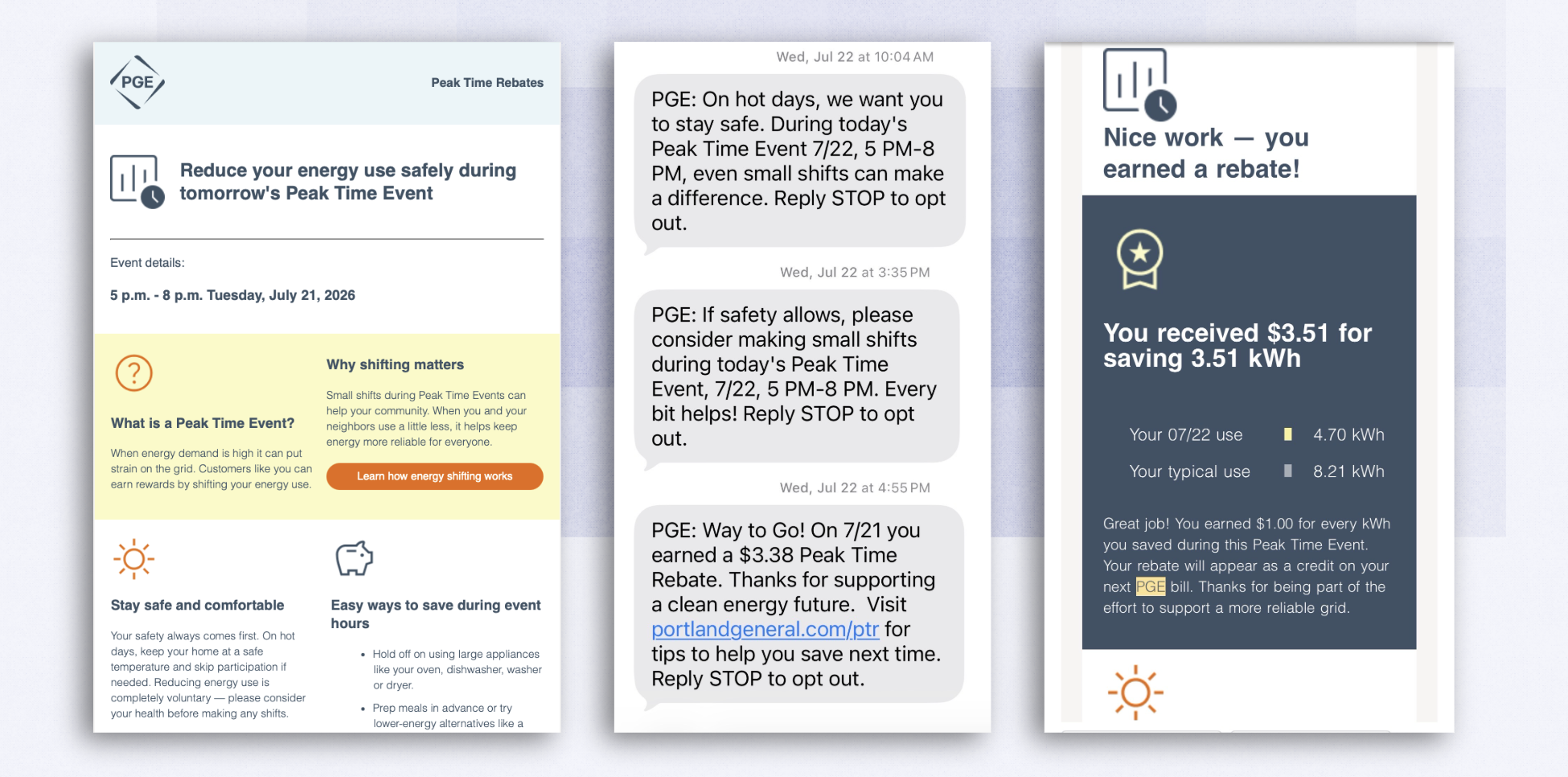
Communication doesn't have to be groundbreaking to be effective, either. I live in Portland and get my electricity from Portland General Electric (PGE). We've had a few short heatwaves this summer (coming in hot, pun intended, from yet another heatwave), and the communication from PGE has been relevant, clear, and informative:
Remind participants often about their enrollment
Proactive communication about enrollment means participants won't be surprised when event season comes around. We recommend reaching out about twice a year with reminders about the program, and at least once before each of your program's busy periods.
Clarify program requirements and boundaries
Does your program allow for overrides or opt-outs? Make sure your members know. While it's of course preferable from an operational standpoint to limit opt-out abilities, enabling participants to make their own decisions increases feelings of agency and inspires positive member sentiment overall. Some utilities strike a balance by providing the ability to override in exchange for a reduction in monthly incentive, or by combining frequent optional events with occasional mandatory events.
Some members may also confuse their thermostat's own smart schedules for a utility program. Most smart thermostat manufacturers have abundant documentation describing these programs, and it's a good idea to provide participants with links to these resources.
Quantify energy savings and bust myths
With a little information, you can inspire participants to see their energy savings in a new light. For instance, even though it is often empirically more efficient to turn off an air conditioner when no one is home, members can get sucked into thinking that cooling the house back down afterwards will result in net higher energy use. The state changes of turning the air conditioner off and then back on feel intuitively important, even when the math says otherwise. Participant education can inspire members to feel better about their participation and even share their newfound knowledge with friends.
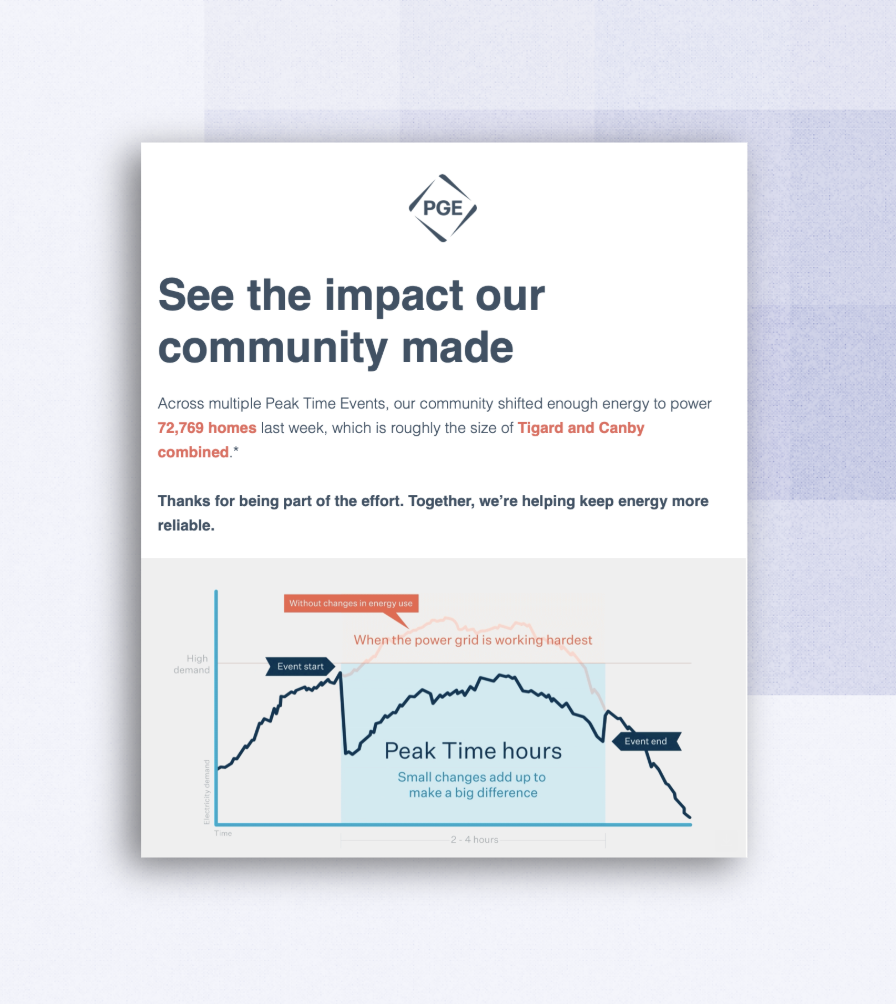
Another myth is that thermostat programs can't do very much to lower peaks. With thermostat programs, "many hands make light work". Renew Home has research that the aggregate is substantial even when individual actions seem small. Utilities may work to bust this myth by quantifying a member's or program's energy savings. This can help participants feel a greater sense of community in the program and encourage them to participate fully in every event.
Below is an event recap email that PGE sent after a July peak event, demonstrating the impact a community's actions can have on the grid:
Introduce personalization options where available
In the past, smart thermostats often assumed a "standard" routine for every household. Members who didn't fit into that standard, like those who worked from home, often felt particularly slighted by schedules that didn't match their schedules.
Now, some smart thermostat manufacturers and utilities have been working to build programs personalized to the member. These programs pair collective scheduled events with more frequent micro-shifts. Participants feel respected and able to participate in a way that feels authentic.
Specific considerations for EV charger programs
Members who adopt EVs are likely already feeling positive about their contributions to protecting the environment, and a well-functioning charger program can evoke even more goodwill. This is largely a function of effort versus return: A member is unlikely to even notice an hour's delay in EV charging, but that delay can represent a significant reduction in peak energy usage.
Maintain trust and predictability of EV charging
Of course, that positive outlook assumes the charging will happen eventually. The primary way an EV charger dispatch policy can protect member experience is by ensuring there are no technical malfunctions or unscheduled charging disruptions. If a member gets in their car to go to work and sees a 20% battery, their sentiment toward the program will change dramatically.
Clear eligibility conditions & easy enrollment
Well-received EV charger programs have clear eligibility conditions, frictionless enrollment flows, and comprehensive operational visibility. This creates a program that participants are genuinely proud to be a part of.
Specific considerations for home battery dispatch programs
Like EV charger programs, battery dispatch programs are a great candidate for positive member experience because of how hands-off these programs can be. Most members install home batteries in order to have a backup during a power outage, and they don't worry about a bit of managed discharge at other times.
Communicate with members about reserve charge levels
Alignment around reserve charge levels makes all the difference for member experience with home battery dispatch programs. Offer this information early and often: in marketing materials, during enrollment, and in FAQ materials. Make sure to specify any scenarios in which battery reserves will be different, like if you plan to preserve more capacity immediately before an expected storm.
Create and abide by eligibility and/or exclusion criteria
Be careful to consider medically vulnerable members when constructing dispatch policies. These participants often need a much higher battery reserve capacity, or may need to be excluded from the program entirely.
A good member experience around home batteries will provide participants with security during outages, and a reasonable reserve level otherwise.
Considerations for building member-forward dispatch policies
Creating a positive experience for your members is critical to the success of grid flexibility programs. Texture supports cooperative utilities around the country with a platform that ensures frictionless programs that deliver real results for utilities and a positive experience for members. Program operations teams rely on Texture's wide-reaching integrations that help them build and run programs that respect member experience without losing sight of load-reduction goals.
