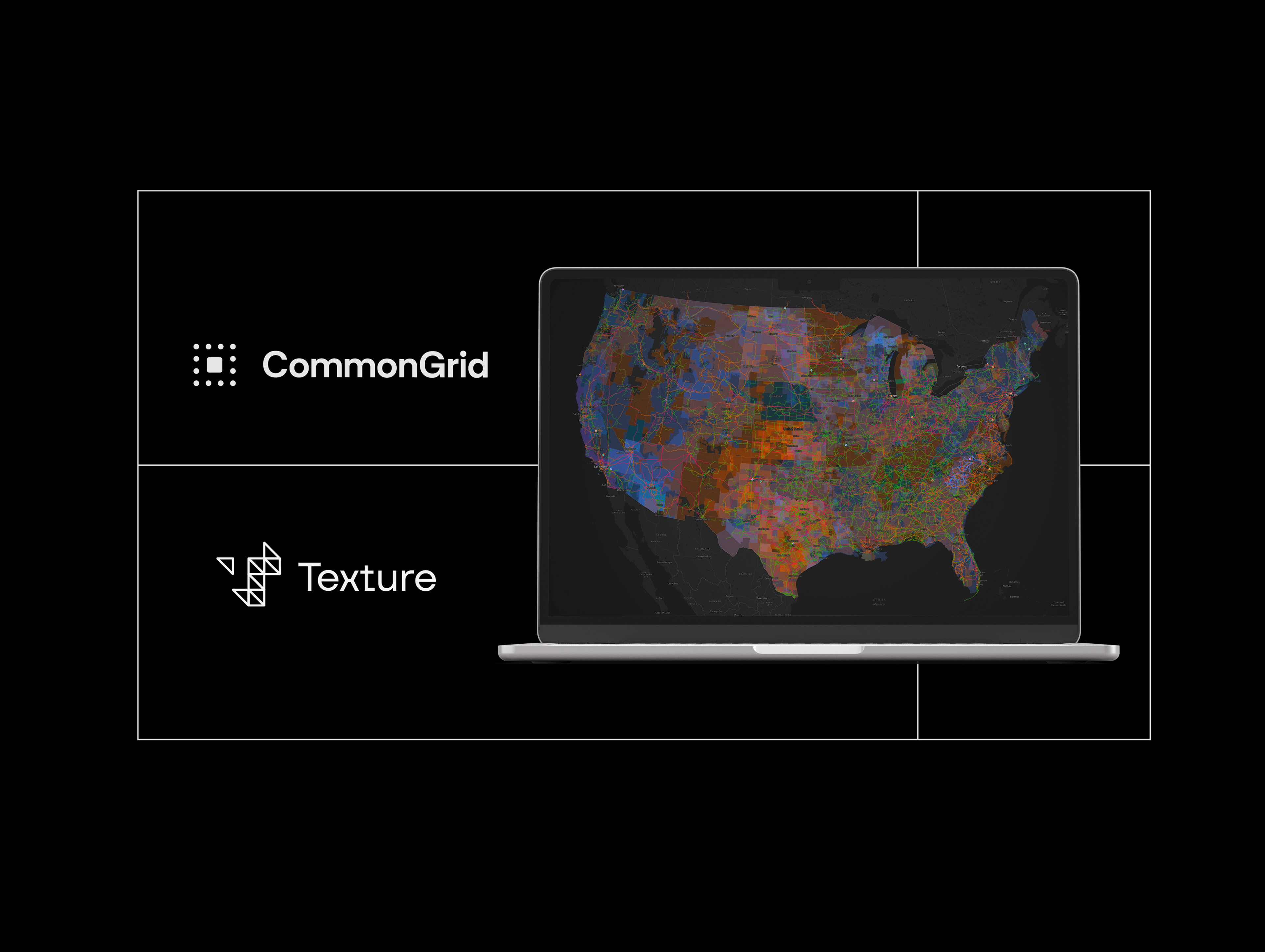
NEW YORK, NY – September 17, 2026 - Texture, the grid operating platform bringing AI to energy teams, today announced the release of CommonGrid, an open model of U.S. energy infrastructure that anyone can use, cite, and correct. Built and moderated like Wikipedia, CommonGrid connects every U.S. electric utility, grid operator, power plant, and major asset into a single structured model, where every change is attributed to a contributor, cited to a source, timestamped, and reversible. A grid model this large stays accurate only if the people who work on it can fix it, which is why CommonGrid is built to be corrected rather than published once.
The release of CommonGrid comes as the U.S. grid undergoes the fastest, most consequential change in its history, with a surge in demand from AI and electrification, a wave of new distributed and intermittent generation, and aging infrastructure all colliding at once.
There are already many worthwhile efforts to open pieces of the grid, but until CommonGrid, a complete view of the ever-evolving system hadn’t been aggregated and mapped, only existing in fragments across hundreds of separately-maintained public sources. This new shared registry is a connected data model with a searchable map, open APIs, source-level provenance, contribution history, and moderation.
“No single company can keep an accurate model of the U.S. grid on its own. Utilities launch programs, rates change, assets get retired, and the people who know about those changes first don't work here. So we borrowed the model that works for Wikipedia: anyone can propose a change, and every change carries its source and its history,” said Victor Quinn, Co-founder and Chief Technology Officer at Texture.
CommonGrid’s public, structured, relational database includes every U.S. electric utility, territory, ISO, market node, and major grid asset. It’s built and moderated like Wikipedia, with every change attributed to a contributor, cited to a source, timestamped, and reversible. It was built by Texture from hundreds of public sources and is now shared with the communities connected to the grid.
“The grid is changing faster than any one organization can keep up with. Every co-op and utility we work with has rebuilt some version of the same map, who serves where, what programs exist, and each one ends up with a slightly different answer. CommonGrid makes that a shared public record instead of a hundred private ones, and it gets more accurate every time someone who knows their own system corrects it,” said Sanjiv Sanghavi, Co-founder and CEO of Texture.
What CommonGrid Includes
Today, CommonGrid connects a huge breadth of grid data into a single graph, with every entry point connecting to the same underlying model:
- Electric utilities: every U.S. IOU, co-op, muni, and federal power agency
- Grid operators: ISOs, RTOs, and balancing authorities that coordinate dispatch and reliability
- Power plants: solar, wind, nuclear, gas, and hydro assets over 1 MW
- Transmission lines: high-voltage lines from 69 kV to 765 kV, spatially queryable and attributed to owners
- EV charging stations: every public AC and DC station in the U.S., with network and plug-standard details
- Pricing nodes: wholesale market nodes across seven ISOs/RTOs
- Substations: normalized from OpenStreetMap, filtered to 69 kV and above
- Programs and rates: demand response, rebates, and tariff structures, queryable by territory
Anyone can propose an edit, and changes are reviewed by an elected moderation team before merging into an hourly snapshot. Each record carries a full edit history, so a researcher can cite a specific revision and an auditor can see exactly who changed what, and when.
How to contribute to and use CommonGrid
CommonGrid is built to be corrected. Anyone can “suggest edit” on any record, and most edits are reviewed and live in hours.
One place to start: municipal utility boundaries. We’re seeking community help to improve the muni service areas. Investor-owned utility and cooperative territories are already in good shape, but municipal boundaries are thinner and need local knowledge to get right.
Researchers and developers can also work with the data directly, through the REST API (60 requests an hour without a key, 5,000 with a free one) or by pulling weekly database snapshots in SQL or GeoJSON from the CommonGrid GitHub repository.
Open Source and Built to Stay That Way
CommonGrid is released under the Open Database License (ODbL) 1.0, the same license that governs OpenStreetMap. It can be used commercially, redistributed, and built into products, with the only obligations being attribution and sharing improvements back to the project. Texture funds the infrastructure; the project is designed to govern itself.
About Texture
Texture is a grid software platform bringing AI to energy teams. Built for the decisions utility operators make under pressure, Texture connects to any meter, device, or data source and provides real-time monitoring, outage detection, transformer load tracking, and DER coordination. Co-ops, municipal utilities, and energy companies use Texture to prevent hardware failures, manage rising load, and coordinate distributed resources without enterprise budgets or multi-year implementations. Headquartered in New York City. Learn more at texturehq.com.
Media Contact
Media@twentytwo&brand
202-798-1986