
At a glance
"My main goal is to build programs that can sustain themselves after the initial grant funding runs out. Texture is helping us support more hardware and strengthen our reporting, creating a foundation for long-term success."
— JJ Vandette, Director of Special Projects & Innovation at Washington Electric Cooperative
Washington Electric Cooperative (WEC) operates in Vermont, a state at the forefront of innovation in energy efficiency.
When members asked for an EV charging program, WEC procured grant funding to cover the initial expense of setting up device integrations. Version 1.0 of the program was popular, but it supported limited hardware, required significant manual administration, and offered little visibility into device performance. To continue beyond the grant period, WEC needed a more scalable and financially sustainable approach.
WEC selected Texture to streamline enrollment, expand support across EVs and chargers, and centralize telemetry and reporting. Within four months, the program processed 150+ enrollments, including 45 that were net-new, and added support for four additional EV and EVSE manufacturers.
Impact highlights:
- 150+ enrollments in 4 months
- Added 4 new EVSE and EV manufacturers, including Tesla and Rivian, bringing the total to 6 OEMs supported
- Greater visibility into program performance, with device-level telemetry and NISC-compliant bill credit reporting
The road to more effective managed EV charging with Texture
It's not easy to enable an EV charging program from scratch. When WEC first went looking, technology partners either didn't have the integrations WEC needed to cover BYOD or were prohibitively expensive. Even though WEC had an estimated 400 EVs in their service area, integrations with major manufacturers like Tesla or Rivian were out of the question. And getting members to replace their Level 2 chargers with compatible hardware was not much more realistic.
Pilot program: PowerShift, a utility-provided device program
WEC's pilot PowerShift program, a utility-provided device program, was successful in reducing monthly and annual peaks, but it required significant manual operation and only supported two hardware manufacturers: ChargePoint and Emporia. To participate in PowerShift, members would send WEC screenshots of their schedules as verification for enrollment, but the co-op had no real-time visibility into how the program was performing. Any device data that was available was scattered across disparate dashboards, making it difficult and extremely time intensive to document program performance.
"Before Texture, we were relying on a hope and a prayer that people would keep operating their chargers in the way they were supposed to."
— JJ Vandette, Director of Special Projects & Innovation at Washington Electric Cooperative
Fortunately, WEC secured a grant to absorb the initial cost of launching more integrations and improving the operational pains of their pilot. The question then became how to make the program viable long-term.
With ROI top of mind, WEC opened an RFP process with an extensive list of requirements, most notably:
- Direct access to EV telematics from Tesla, Rivian, and more
- Support for monitoring both EVSEs and EVs in one place
- Low-touch enrollment, with minimal operational hassle as members moved through the program
- More pathways for BYOD members to engage with the program, including support for Tesla and Rivian vehicles
- Effective monitoring, with action items proactively pushed to responsible parties
- Robust reporting at the click of a button, with real-time visibility into device telemetry
At the end of the RFP process, WEC selected Texture as their technology partner to build out an improved EV charging program. Texture enabled more streamlined enrollment flows, new hardware integrations, and greater visibility.
Faster, smoother EV charging enrollment & onboarding for members
Texture worked with WEC to create flexible, white-labeled enrollment flows that made enrollment easier for participants.
One flow was intended for legacy participants, and the other for enrolling net-new participants, with conditional logic to identify members requiring utility-provided devices.

Setup and maintenance on the onboarding forms was a collaborative process, with Texture helping generate the forms for each enrollment flow. This freed up the WEC staff to focus on other aspects of the program while retaining full control of the details.
Adoption of the new enrollment forms was eye-opening. Within 4 months, WEC had processed 150+ enrollments, including 45 net-new participants. Given the total EV ownership in their service area is estimated at 400 vehicles, this represents a significant portion of WEC's addressable market.
Surprisingly, many of these signups came from mobile devices. With no way to track application origin before, WEC hadn't been aware that so many members were signing up on their phones from an emailed link. Texture's mobile-optimized flows helped support their member experience without any additional effort on WEC's end.
And not only did the application experience meet members where they were, it also required less manual input. For example, some members enrolling in the pilot program had historically needed to fill out a load sheet to quantify impact on transformers. Now, WEC can surface that information using Texture, and members don't need to find a qualified electrician to help with the paperwork.
Overall, WEC stood up complete enrollment flows with Texture in just 30 days.
"Texture delivered on its promise to get the program up and running quickly. The speed of implementation was impressive. We had almost 100 devices enrolled in 30 days."
— JJ Vandette, Director of Special Projects & Innovation at Washington Electric Cooperative
Broad EV & EVSE compatibility including Tesla, Rivian, & Volkswagen
One of the reasons WEC chose to partner with Texture was Texture's out-of-the-box hardware compatibility with multiple EV and EVSE manufacturers.
Previously, WEC could only support ChargePoint and Emporia chargers. Today, members can also enroll vehicles from Tesla, Audi, Volkswagen, and Rivian, all without any additional integration agreements, contracts, or negotiations.
The vehicle BYOD component of the program is increasingly intriguing for members. In the first four months, 65% of net-new enrollments directly connected EV telemetry. The direct-to-vehicle connection made the program more accessible to early EV adopters as well as those who already owned a Level 2 charger.
Perhaps the biggest impact for WEC's team was that the expanded OEM support and direct EV telemetry required minimal operational support on WEC's end. Like most co-ops, WEC doesn't have the bandwidth to dedicate engineering resources to building and maintaining each integration. Because Texture's integrations work out of the box and keep working even when manufacturers change an interface or API hook, WEC benefits from increased hardware compatibility without shouldering the burden of creating and maintaining bespoke integrations.
"At our size, it can be nearly impossible to engage directly with some vehicle manufacturers. Texture makes those integrations achievable for a co-op like ours."
— JJ Vandette, Director of Special Projects & Innovation at Washington Electric Cooperative
Greater visibility into telemetry
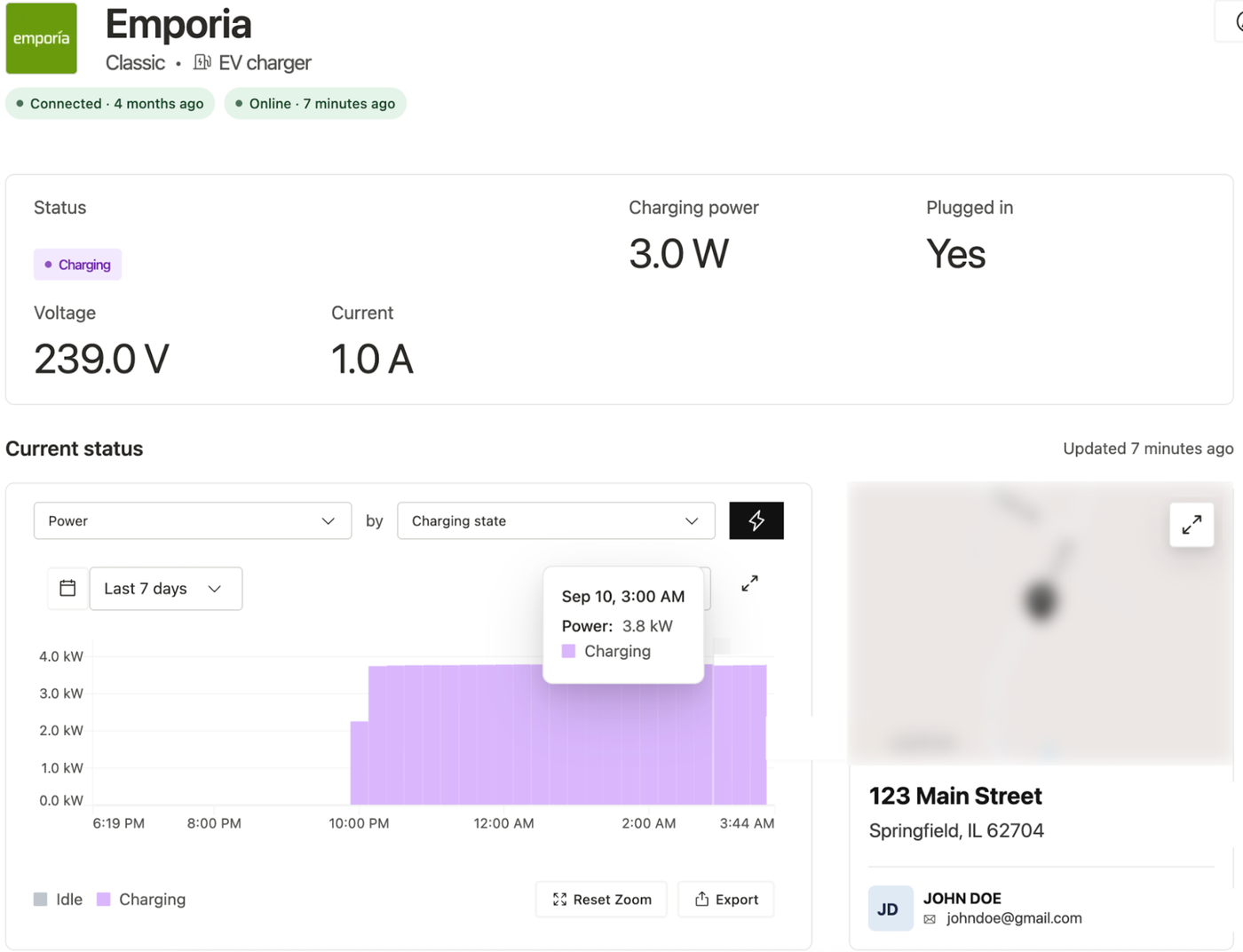
WEC also needed a unified view of program performance, and for that, they turned to Texture's all-in-one platform for monitoring device telemetry data.
Having all of the EV and EVSE device data aggregated in one platform allowed WEC to monitor program effectiveness in detail, in real time. Previously, analysts would need to swap between tabs and manually collate aggregate device data. Now, WEC can easily download NISC-compliant bill credit reports, along with any other information they'd like about the program. Texture's interface shows when devices go offline, how much energy those devices are using, charge status, connection status, and aggregate program metrics, among other valuable details.
Texture's telemetry and reporting features make WEC's incentive-based managed EV charging program easier to run. Real-time telemetry helps when troubleshooting technical issues, and customizable reports mean more quantifiable success stories, more innovation, and greater peak load reduction.
"We're a smaller co-op without a control center, a dispatch team, or someone dedicated to real-time monitoring. Texture gives us a streamlined way to keep an eye on technical issues."
— JJ Vandette, Director of Special Projects & Innovation at Washington Electric Cooperative
Looking ahead to a battery program
Buoyed by the success of their EV charging program, WEC is looking ahead to a residential battery program. Active control and support for Tesla batteries are two major requirements, and they already know Texture can meet those needs. It's just a matter of deciding how to structure the program, and knowing Texture will handle the rest of the logistics.