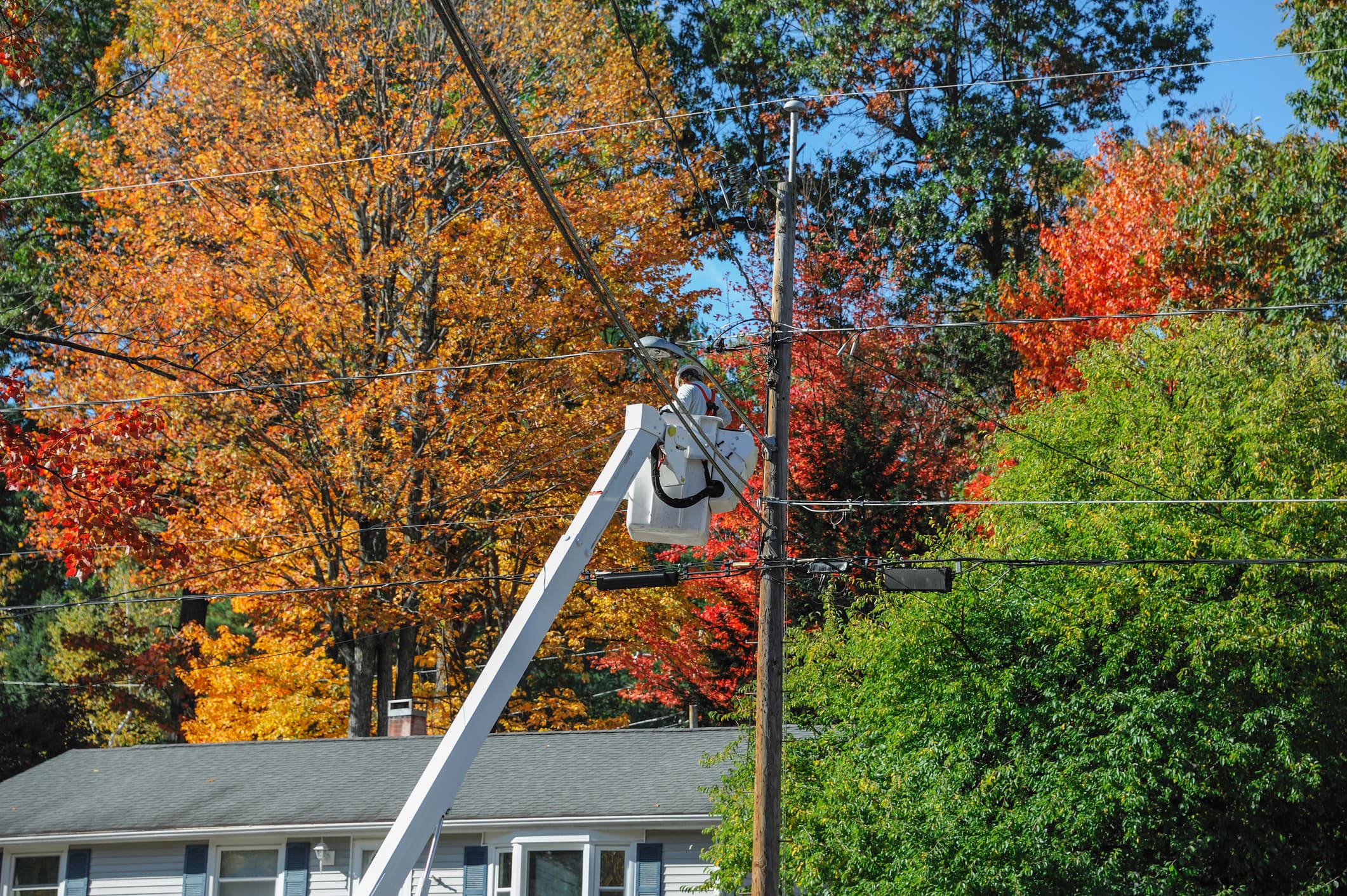
When lineworkers go out to perform maintenance or restore an outage, one of the key questions that arises is who is responsible for making sure the line stays dead until they climb down?
A tag is not what keeps a lineworker alive. The training, PPE (Personal Protective Equipment) and physical grounds that are applied to the line do that job. The tag puts one name on the clearance so there is never a question about who can put the line back.
What is a clearance?
A clearance is the formal authorization to work on a specific de-energized section, granted by the system operator or dispatcher to one named person. It has boundaries both sides have agreed on, and it has a single holder from the moment it is issued to the moment it is released. The operator will not touch anything inside those boundaries until that person releases it.
How does the clearance run?
The sequence is spelled out in OSHA's guidance on deenergizing transmission and distribution lines, and utility switching and tagging programs follow it closely.
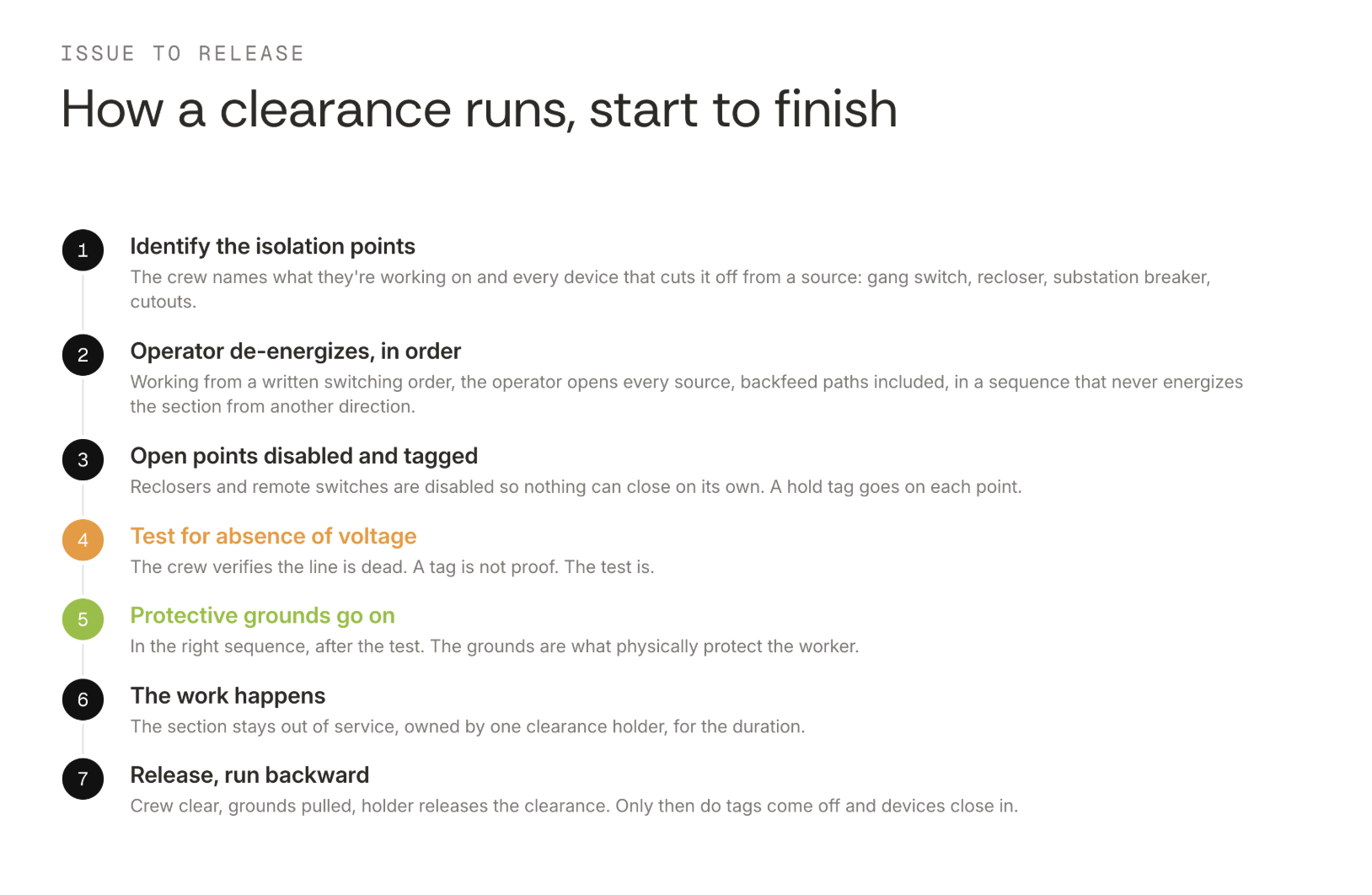
- Before anything is switched, the crew holds a job briefing, sometimes called a tailboard. They cover the hazards, the switching plan, who holds the clearance, the PPE, the weather, the backfeed sources, and the plan if something goes wrong. 1910.269 requires it, and it is the first thing an investigator looks for when a job goes bad.
- The crew identifies what they are working on and which devices isolate it: a gang switch, a recloser, a substation breaker, a set of cutouts. These are the locations and devices that, once opened, cut the section off from every source.
- If there is SCADA, the person in charge of the clearance asks the operator to de-energize that section. If not, they de-energize it themselves. The operator works from a switching order, a written list of which devices are operated and in what order. The workers open every source, backfeed paths included, without energizing the section from another direction.
- Each open point is rendered inoperable and tagged. Reclosers, sectionalizers, and remote-controlled switches get disabled and tagged too, because a device that can reclose on its own is the exact hazard you are removing.
- The operator hands the section to the crew, and the crew tests for the absence of voltage. A tag is not proof the line is dead. The test is. The crew checks the tester on a known live source, tests the line, then checks the tester again on that same source. A tester that failed without anyone knowing is how people die on lines that were called dead.
- Protective grounds go on, in the right sequence, after the test.
- The work happens.
- Then the crew restores power. The crew confirms everyone is clear, pulls the grounds. The holder releases the clearance to the operator. Only then do the tags come off.
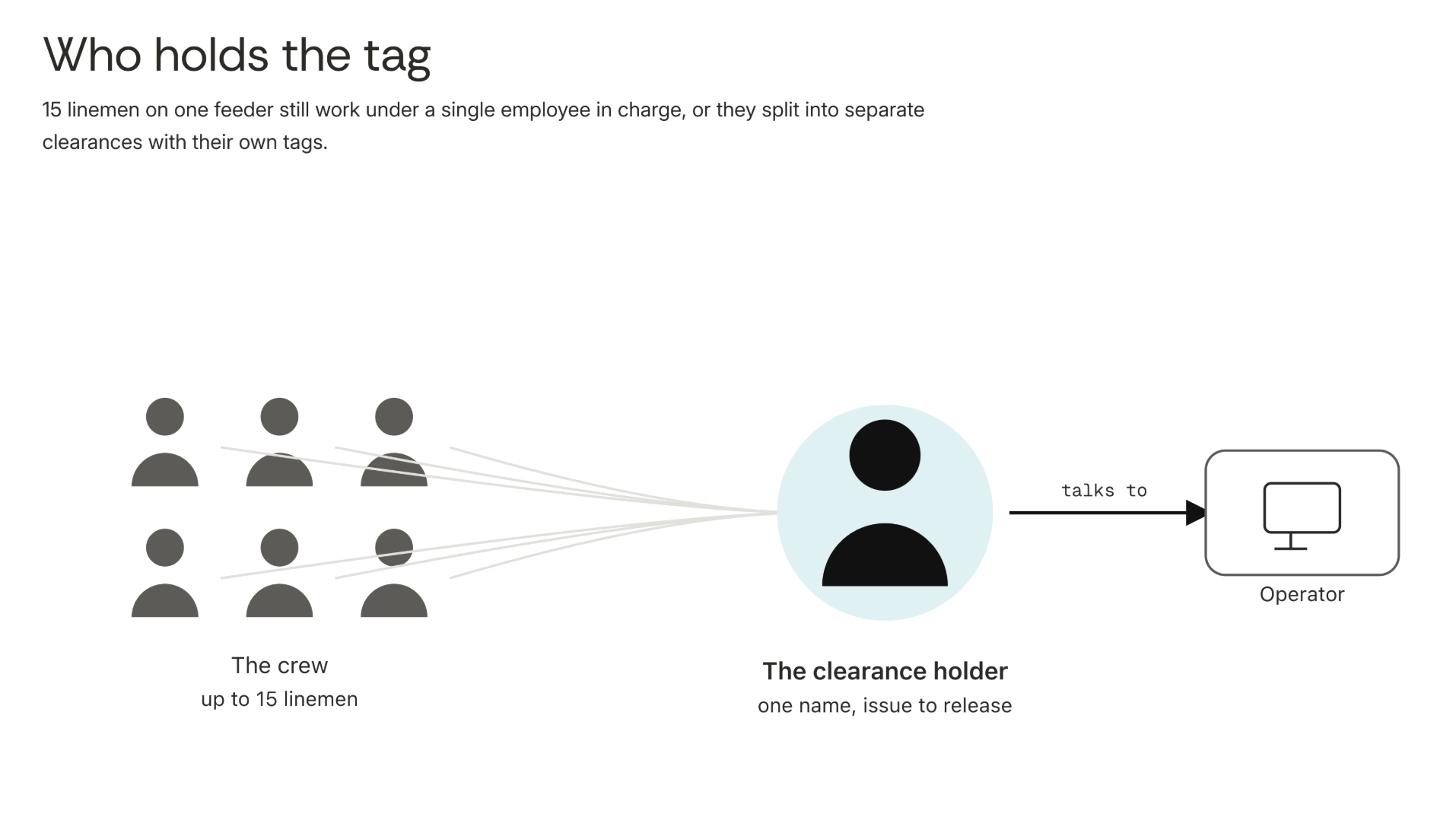
Who holds the tag
One person accepts the clearance and owns it. Not the crew, not the foreman on everyone's behalf. One individual the operator talks to, and the only one who can release it. Until they do, the section stays out of service.
This is deliberate, and the 1910.269 standard requires it. With one accountable person there is no ambiguity about who says the crew is clear. Fifteen linemen from three states on the same feeder still work under a single employee in charge of the clearance, or they split into separate clearances with their own tags. The design exists to answer one question at the worst possible moment. When someone reaches for a switch, who said it was safe to close?
Tag types and colors
People expect tags to run on a national color code, the way traffic signals do. They do not. OSHA requires that de-energized points be tagged, but it does not set a color for switching tags. What matters more than color is the type of tag and the authority behind it.
The hold tag, sometimes called a clearance tag, is tied to an active clearance. It says people are working behind this point, and only the clearance holder can authorize its removal. Then there are information or caution tags, which flag a condition, a device left in an odd state, a note for the next crew, without granting a work clearance or protecting anyone. Reading an information tag as a hold tag is a real hazard, which is why programs keep the two clearly apart.
Colors are set by each utility, not by a national rule, though most programs land on a similar logic. Red is the usual choice for a do-not-operate or hold tag, matching the ANSI Z535 convention where red means danger. White, or another plain color, often marks an information tag, a condition to be aware of rather than a work clearance. Yellow tends to mean caution, a maintenance or out-of-service state. Some go further and assign colors by department or function. More colors do not mean more safety. A program stacked with department-specific colors and layers of signoff gets harder to follow, and a tagging system is only as good as a tired crew's ability to read it right at the end of a long day.
The tag versus the grounds
What physically protects a worker is the set of protective grounds, covered under OSHA's grounding for employee protection guidance. A de-energized line can still come back: a lightning strike, an unknown generation source on a member's roof, someone's backup generator during an outage, a capacitor bank still holding a charge, induced voltage from a parallel circuit running nearby. The grounds do not just drain that current to a ground rod. They bond the work area into an equipotential zone, so everything the worker can touch sits at the same voltage. If the line comes back, the worker is inside that zone and never becomes the path that a voltage crosses. The tag protects the process and the grounds protect the person.
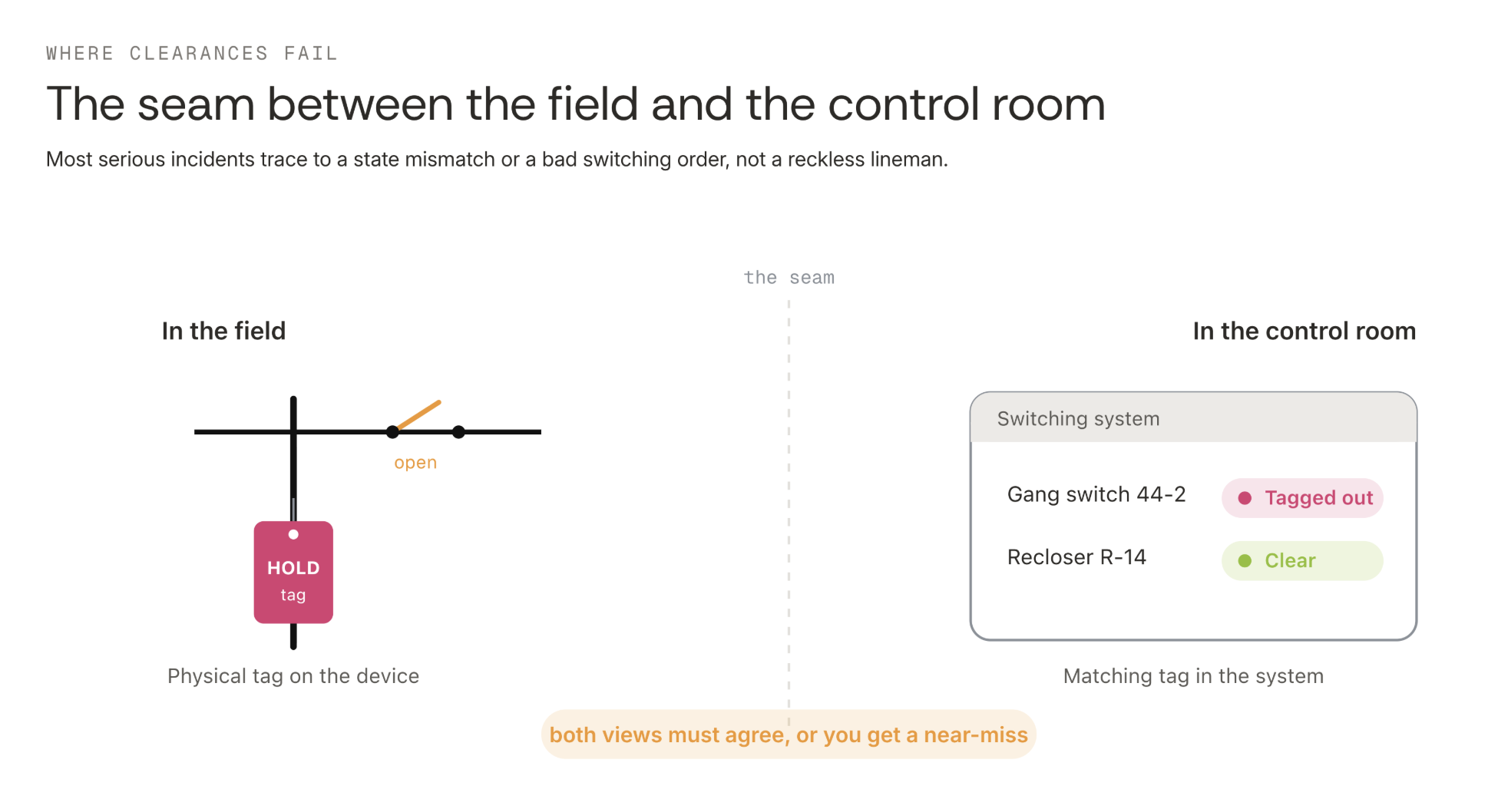
A clearance is only as good as the picture both ends share
A physical tag hangs on a device and a matching tag lives in the operator's SCADA system or dispatcher's records. If those lists are not synced you can get the near-misses. The operator sees a device showing clear while a field tag is still on it. The whole thing rests on field personnel and remote operators in the control room agreeing on the state of equipment neither can fully see.
The short version
A clearance is permission plus ownership: one person, granted by the operator and released only by that person. There are many workers on the system, tree clearing crews, other lineworkers and control center operators with remote control. Tags and clearance are a key element in making sure everyone is working safely.
