Across the country, co-ops and utilities are adding front-of-the-meter batteries to reduce peak costs, manage local constraints, support reliability, and get more flexibility out of existing infrastructure.
During the July heatwaves across the northeast, one co-op we work with dispatched their utility-scale batteries four consecutive days, during peak evening hours, drawing their batteries down from full charge to about 20%, then recharged overnight to be ready again by morning. That standby-then-dispatch pattern is typical for these assets, and we designed Texture to enable it.
These assets are becoming part of everyday operations for utilities, and as battery deployments grow, so does the operational complexity.
Utility-scale batteries often sit near substations or critical grid sites, and each asset may come with its own communication protocol, telemetry format, control workflow, and reporting process.
That fragmentation makes batteries harder to use when they matter most.
Today, Texture supports utility-scale battery monitoring and operations, bringing front-of-the-meter batteries into the same platform utilities already use to manage distributed energy resources across their service territory. I've been building Texture's operational capabilities for utility-scale batteries, and wanted to walk through how it works and what operators can expect with Texture.
Why utility-scale batteries and why now
Electrification is changing when and where demand shows up. Peaks are shifting and becoming more difficult to predict, and infrastructure upgrades are expensive and slow. Operators need tools that can respond faster than traditional planning cycles allow.
Front-of-the-meter batteries can help utilities reduce transmission and capacity costs by discharging during system peaks, manage local constraints near substations or feeders, defer infrastructure upgrades, and improve reliability by making stored energy available when the grid needs it.
For most utilities, these batteries aren't replacing behind-the-meter programs. They're becoming part of a broader flexibility portfolio. A residential battery fleet might reduce peak demand across hundreds of homes. EV chargers might shift load overnight. A utility-scale battery sits near a constrained part of the system and delivers a more direct operational response.
The challenge is bringing all of those assets into one operating picture. That's what we built.
From standalone assets to a single operating environment
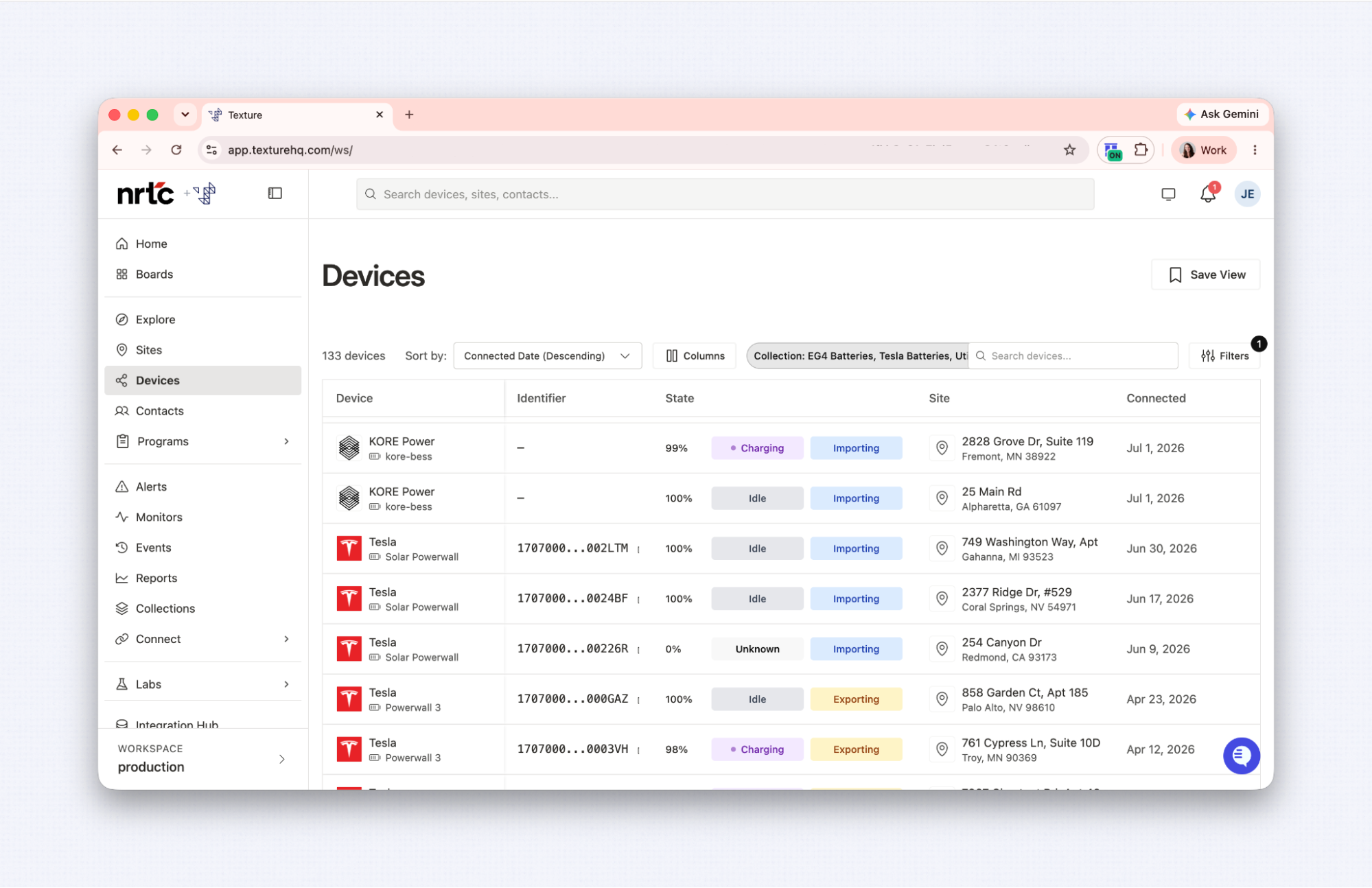
For many utilities, utility-scale batteries are managed through site-specific workflows and vendor portals. That may work for the first battery, and maybe even the second. But as they add more assets across different sites, vendors, and use cases, system operators and system engineers need a simpler way to see what's happening and take action.
Instead of treating each battery as a separate integration, Texture brings the asset into a normalized operating environment. The battery connects either through a manufacturer's cloud API or over industrial protocols like DNP3, and Texture maps whatever signals the asset exposes into a common data model. State of charge, power output, voltage, operating mode, charge and discharge windows, warning states. Every battery manufacturer exposes data differently, but operators shouldn't have to care about that. They should see a consistent view regardless of what's underneath.
The result: a utility-scale battery shows up in Texture alongside the rest of the fleet.
What systems operators can do
We built the utility-scale battery experience around how control center operators actually work.
Nobody in a control center wants to dig through a device page just to confirm everything is normal. Texture's operations dashboard is designed to make battery health a quick glance, with each battery displaying a clear status indicator and receiving regular status updates. Green means normal. Yellow is a warning. Red means something needs attention. Upcoming commands and scheduled events are visible without clicking into anything.
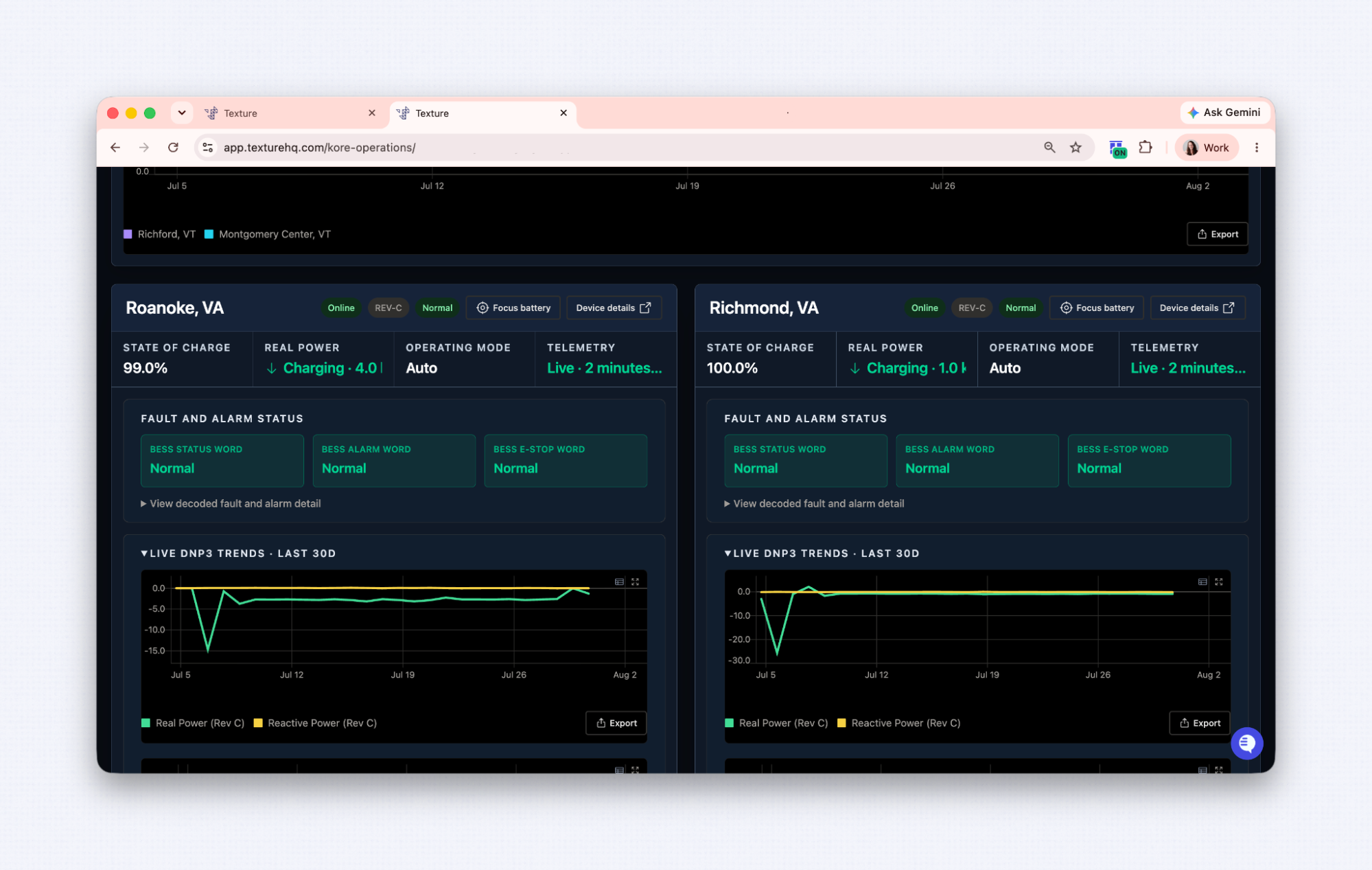
When an operator needs more detail, they can expand into the full device view: state of charge trends, inverter power, reactive power, telemetry freshness, the signals that engineering and operations teams care about. But the default is deliberately simple. Look up, scan, move on.
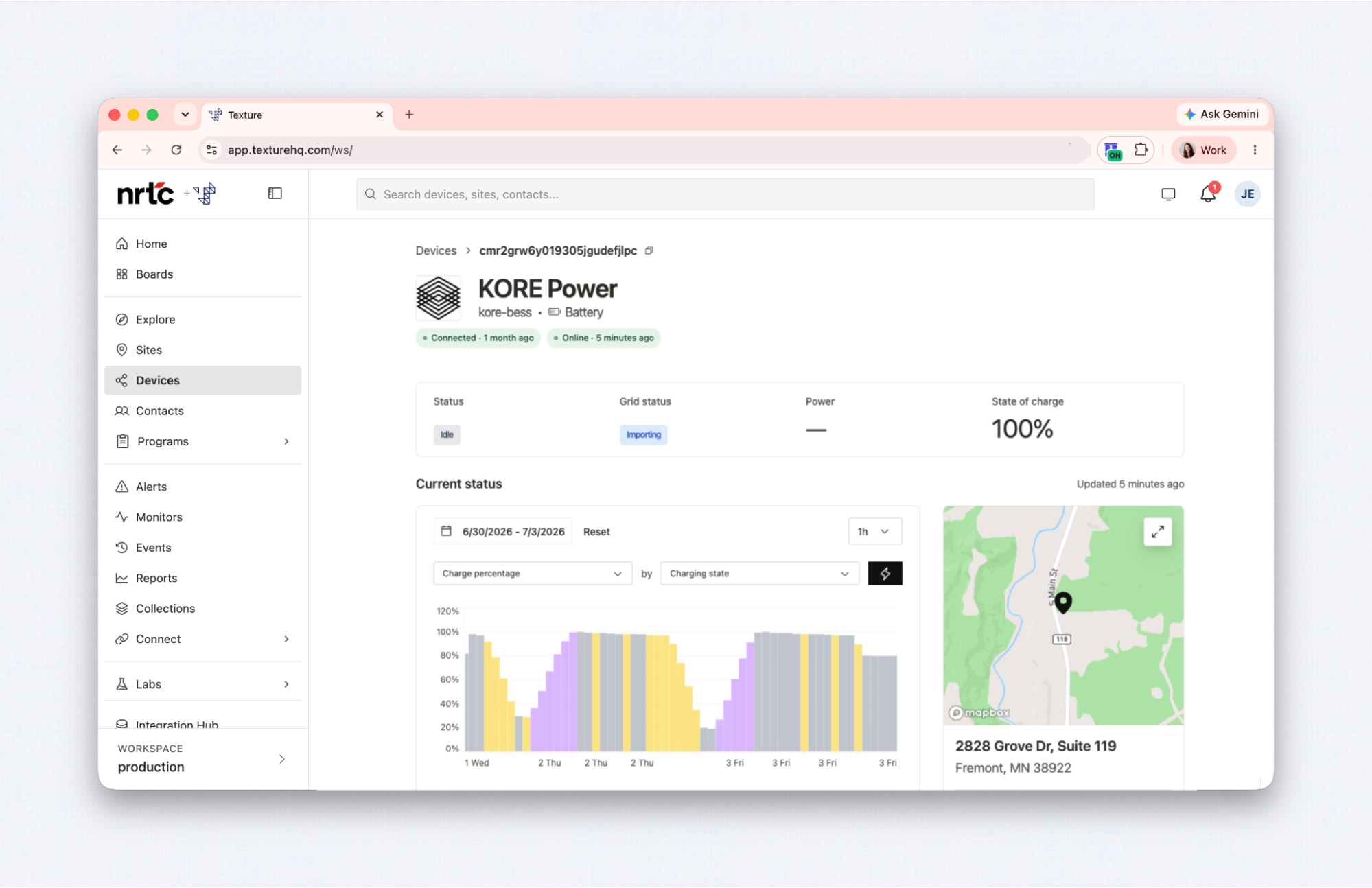
Program dispatch directly from the device
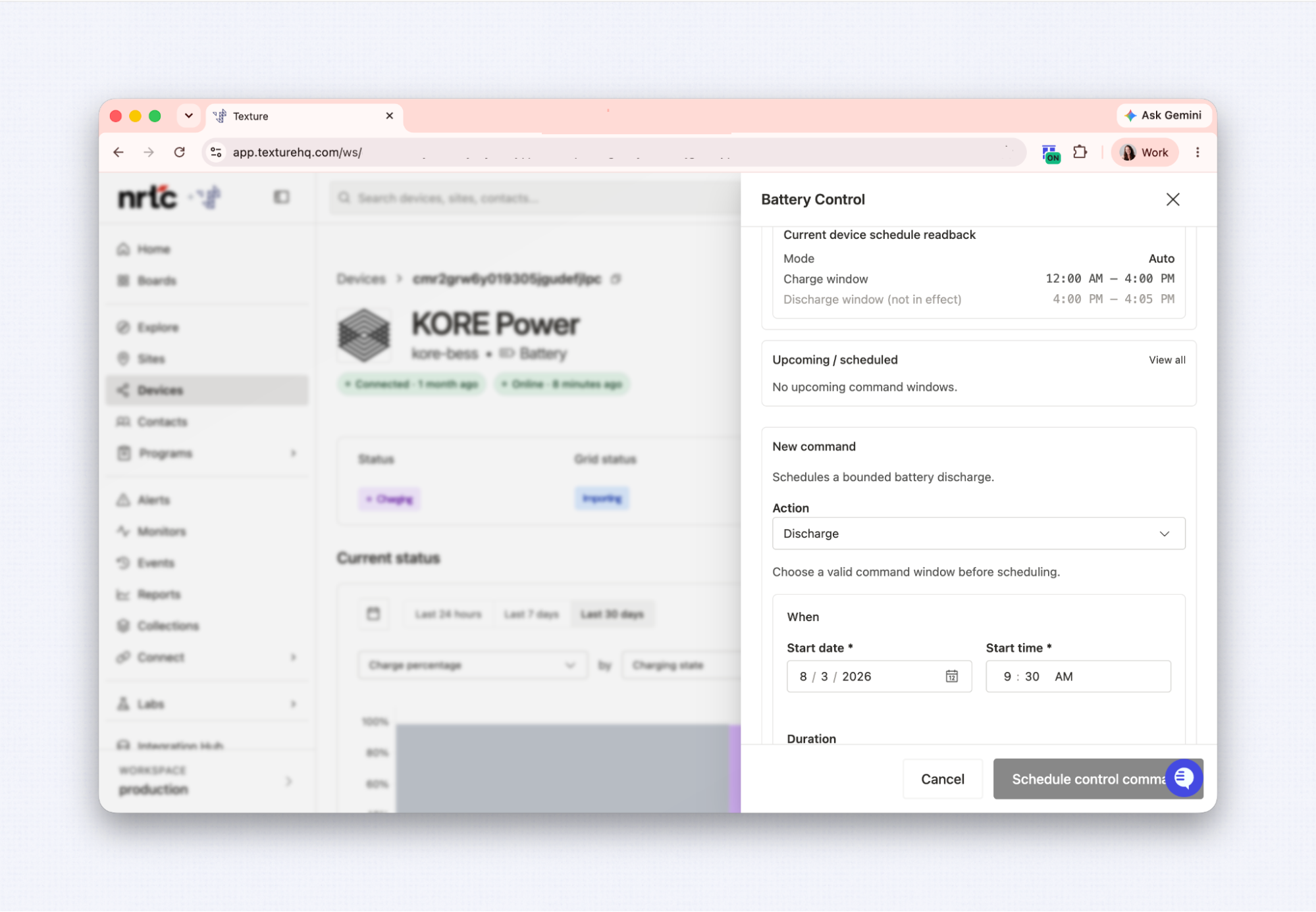
The ability to dispatch directly from the device was important functionality for those operating batteries.
- From the device page, an operator can set a discharge window with a start time and duration.
- They can adjust the charge schedule.
- They can reset the battery to auto mode.
Built-in smoothing logic derates the discharge over the full window so the battery doesn't dump its charge in the first hour.
We also built guardrails directly into Texture.
- There's a configurable minimum reserve so the battery always retains enough charge for emergencies.
- Watchdog behavior returns the battery to a safe state if communication drops.
- And dispatch has to be explicitly enabled per site.
Case study: Utility-scale battery dispatch during the July heatwave
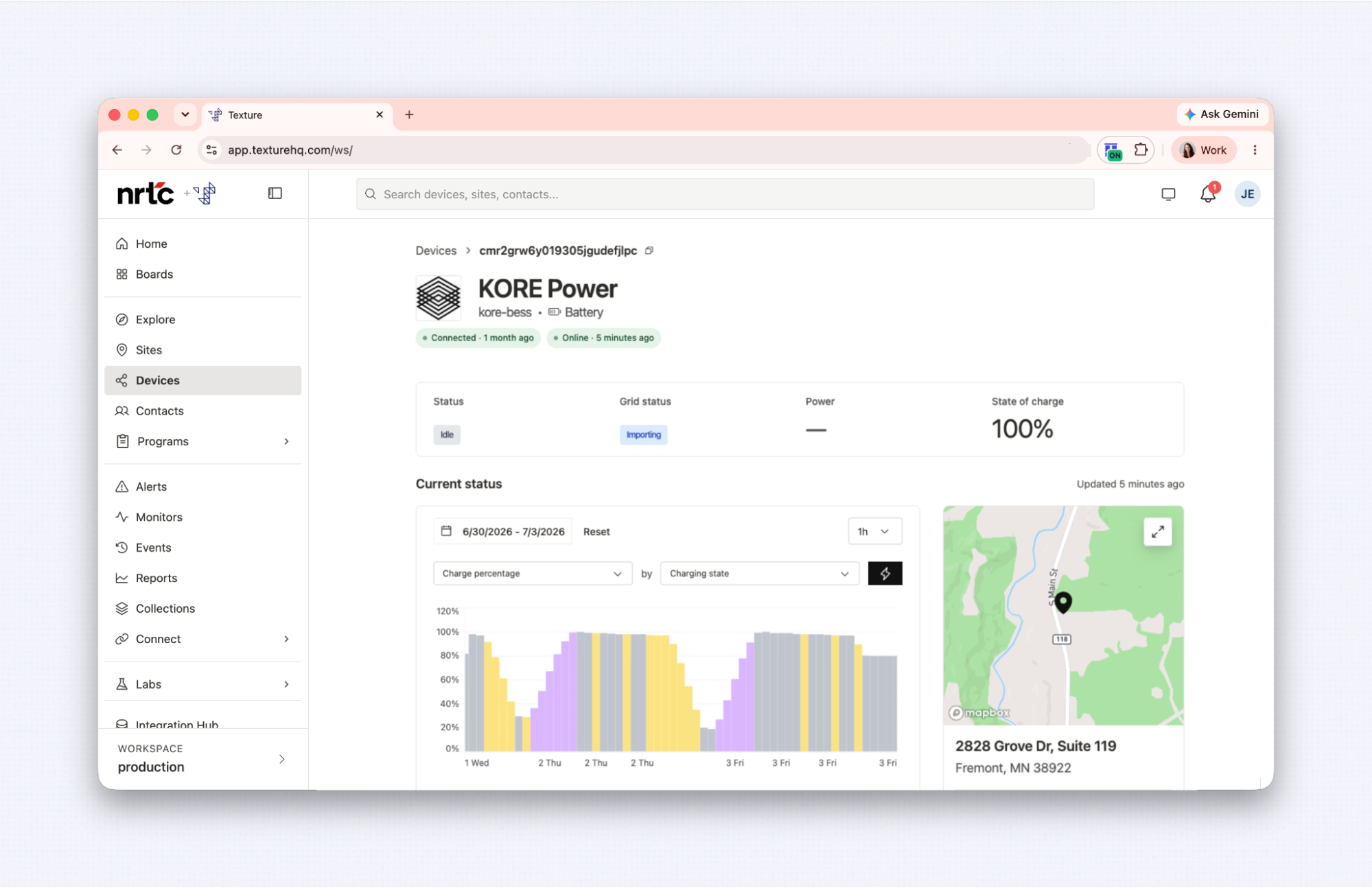
Utility-scale batteries spend most of their time on standby, with telemetry reading as a flat line. Then, during a peak event, everything matters at once.
Texture helps system operators answer the questions that come up before a peak window:
- Is a discharge scheduled?
- What mode is the battery in right now?
- Is the current state of charge sufficient?
- Are reserve requirements in place?
As described at the top of this article, one co-op we work with dispatched their utility-scale batteries four consecutive days during a heat wave this past July. Each evening, the batteries discharged from roughly 6 PM to 10 PM, drawing down from full charge to about 20%. They recharged overnight and were ready again by morning.
That standby-then-dispatch pattern is typical for these assets, and the platform is designed around it: quiet when nothing is happening, clear and immediate when something is.
Built for a mixed DER future
The bigger picture isn't just that Texture can support utility-scale batteries. It's that these batteries can now sit inside a broader grid flexibility strategy.
Utilities are building portfolios with utility-scale batteries near substations, residential batteries through bring-your-own-device programs, income-qualified storage, managed EV chargers, smart thermostats, and other behavioral demand programs. Each resource has different operating characteristics, different users, and different data.
Texture makes it possible to manage both behind the meter and front of the meter assets all in one platform.
Getting started
If your utility operates front-of-meter batteries or is planning to soon, Texture can bring those assets onto the same platform where you're already managing residential DERs. Visit our utility-scale batteries documentation for a technical look at how the integration works, or reach out to our team to talk through your setup.
