Everyone has seen it. The lights blink, come back, blink again, come back, blink a third time, and then the power goes out. That sequence is not the grid failing. It is the grid protecting itself, and watching it happen tells you most of what you need to know about how protection works.
Faults on the distribution system are constant. A branch sags onto a line, lightning strikes, an animal bridges a conductor, a piece of equipment fails. While it would be great if everything were underground, equipment never failed, and we know of problems ahead of time that's not the reality.
The grid cannot avoid issues completely, so instead it is built to deal with it automatically, fast enough that most of the time you barely notice. The job of a protective device (breakers, reclosers, and fuses) is simple to state and hard to do well: clear the fault before it burns something down or hurts someone, and take as little of the system offline as possible while doing it.
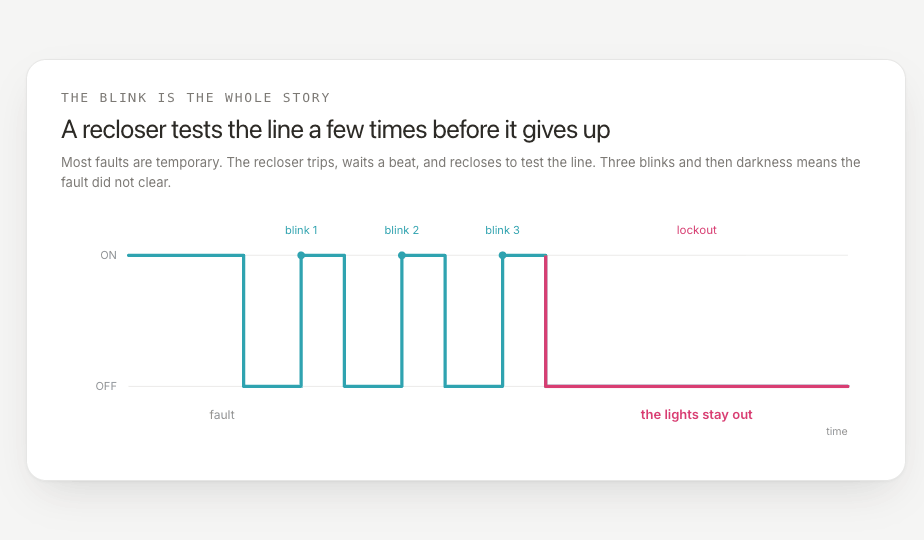
The blink is the whole story
Here is the thing most people do not know. The large majority of faults are temporary. By most counts, temporary faults make up roughly 75 to 90 percent of overhead distribution faults, so treat that as a rule of thumb rather than a fixed number. The branch brushes the wire and falls away. The animal is gone. The lightning has passed. The fault is there for a moment and then it clears on its own.
The devices, plainly
Protection is a handful of devices, each with a clear job.
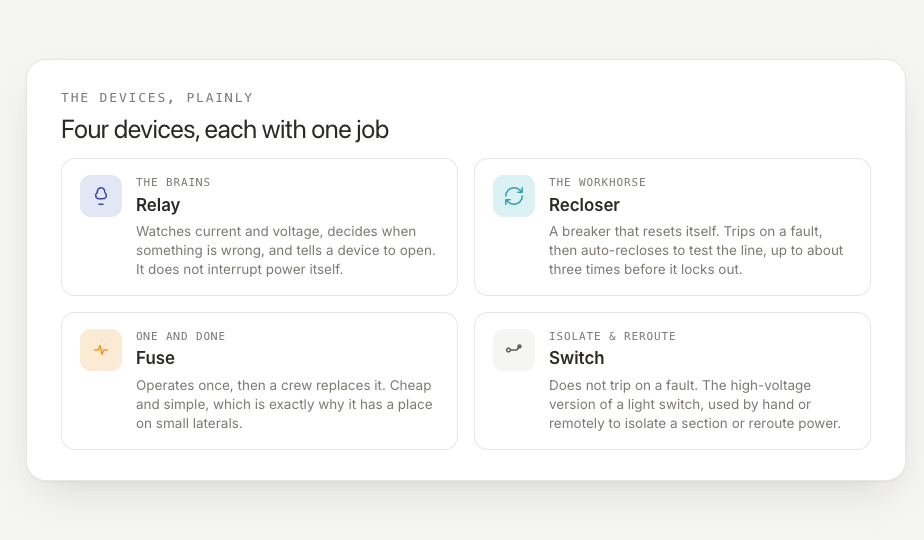
Relays are the brains. They watch the current and voltage, recognize when something is wrong, and tell a device to open. They do not interrupt the power themselves. They make the decision.
Reclosers are the workhorse. The easiest way to picture one is a circuit breaker like the one in your house, except you can set it to whatever size the load needs and, in its modern form, control it remotely. A home breaker protects your wiring and you flip it back by hand. A recloser protects a whole neighborhood and resets itself. They come in two flavors. Electronic reclosers can be controlled remotely, can be set to any size and grown as load grows, and cost something like thirty to seventy-five thousand dollars. Hydraulic reclosers are far cheaper, around five thousand, but they are fixed in size and you cannot operate them remotely.
When it sees a fault, it trips open, waits a beat, and then closes again to test the line. If the fault has cleared, power is restored and all you saw was a blink. If the fault is still there, it trips and tries again, usually up to about three times. The pause between attempts is partly there to let the arc de-ionize, which is one reason a recloser's open and reclose cycle is timed the way it is. If the line is still faulted after the last attempt, the recloser locks out and stays open. That is when the blink becomes an outage.
Fuses are one and done. A fuse is a car fuse, but much bigger. It operates once, then a crew has to go out and replace it. It is cheap and simple, which is exactly why it has a place.
Switches are the odd one out. They do not trip on a fault on their own. They are the high-voltage version of a light switch, the means to isolate a section or reroute power by hand or remotely. They sit alongside protection and do the work of carving the system into pieces you can de-energize and restore.
Coordination is the real skill
Here is the part that separates a good protection scheme from a bad one. You do not want all reclosers.
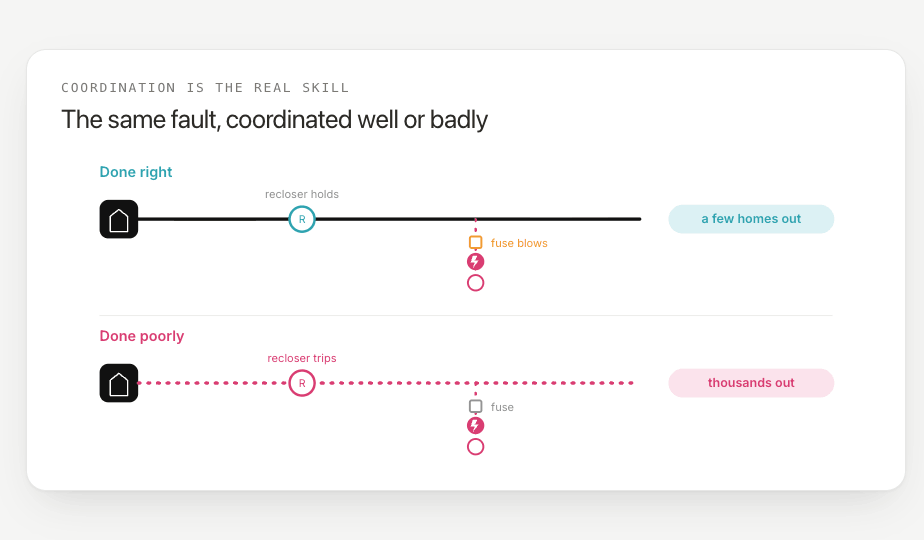
A recloser is powerful and expensive, and if you put one everywhere, every small fault on a tiny lateral has the potential to operate a device that controls a big chunk of the system. So protection is a hierarchy, and it is an economic choice. You match the device to the load it protects. A fuse guards a small tap serving a few homes. A recloser guards a larger section worth the cost of one. The whole thing is then coordinated so the device closest to the fault operates first.
Done right, a tree on one small lateral blows a single fuse and takes out a few homes, while the recloser upstream never moves and the rest of the feeder never notices. Done poorly, that same tree trips a recloser and drops a few thousand members instead of five. Coordination is the difference, and it is most of the art in protection engineering.
Same device, opposite setting
One more thing worth knowing, because it shows how protection bends to conditions. The automatic reclose that saves you on a windy afternoon in March, restoring power after a branch clears, is the exact behavior you disable during high fire risk. In fire weather you do not want a line re-energizing into a possible ignition, so you put the recloser in a non-reclose posture and let it trip once and stay open. The industry term for this is reclose blocking, and utilities in fire-prone areas turn it on during the highest-risk days. Same device, opposite setting, because the risk changed.
The catch worth knowing
Every protective operation is a signal. A recloser that keeps tripping on the same feeder, or a fuse that keeps blowing on the same tap, is telling you something is wrong out there, whether it is a failing piece of equipment, a tree that needs trimming, or a wildfire risk building.
The trouble is that you cannot always hear it. A modern electronic recloser reports its operations, so you can see the pattern. A fuse or a hydraulic recloser is silent, and you often find out it operated when a member calls. And knowing what a lockout actually costs you, which members and which loads sit downstream of each device, depends on having an accurate connectivity model. The protection works whether or not you are watching. Getting value from what it tells you is a separate problem.
The short version
Protection exists to clear faults fast and affect as few people as possible. Most faults are temporary, which is why a recloser tests the line a few times before it gives up, and why your lights blink before they go dark. Relays decide, reclosers and fuses act, switches isolate, and coordinating them so the smallest device closest to the fault operates first is the real skill. The settings bend to conditions, and every operation is a signal, if you have the means to see it and the model to understand what it affects.
